Posted on Leave a comment

Breath Taking

Unique staircases and walls in our mountainous Black Hills towns are both practical and charming

By Paul Higbee

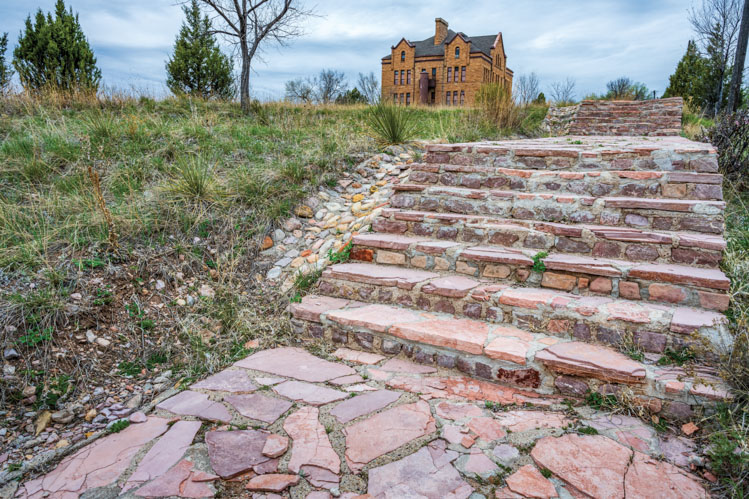
AS AN 8-year-old I envied Hot Springs kids. Visiting from Iowa, I always noticed where children in other towns walked to and from school. Hot Springs had built-in adventure. There were sidewalks along a steaming river and a long flight of stone steps from downtown to a hilltop school overlooking town.

A stone staircase climbs the hill to the Pioneer Museum in Hot Springs.

I imagined enrolling at Hot Springs and bounding up those stairs like a mountain goat every morning and then, at 3, leaping down three steps at a time with plenty of hang time, like a hawk dropping back to earth.     

Southwestern South Dakota had three things my region of Iowa didn’t: thermal springs, contrasting elevations to negotiate, and a ready supply of pink sandstone with which to build. In the late 19th century Fred Evans and others quarried that sandstone for distant markets, but kept much of it for shaping their town. Hotels, hospitals, sanitariums and covered pools were created, making Hot Springs what we’d call today a medical tourism destination. People from everywhere, with a wide range of ailments, arrived by train seeking remedies in naturally warm waters.

“An important part of her work in healing the sick and recreating the tired vacationist is that she should always appear trim and smiling,” wrote poet and historian Badger Clark in his classic When Hot Springs was a Pup. “Beauty is her business.” The soft glow of pink sandstone contributed to that, whether worked into the architecture of the incredible Evans Hotel or State Soldiers Home, or into something as practical as a retaining wall or exterior stairway that moved patients from hotel lodgings to therapy.

There’s a price to pay for beauty, though. Mayor Bob Nelson reports the two oldest stairways have been city maintenance challenges for a long time. “Because of their deteriorating condition, the city has closed these sets of stairs for safety reasons,” he says, but that doesn’t mean they’re abandoned. Hot Springs hired a firm to look at the design and cost of replacing the steps, with the idea being to keep the original look and feel. “It’s early in the process,” Nelson says, but the firm’s report will put Hot Springs “in a better position to look for grant opportunities to help fund the replacement of the stairs.”

Challenge Dakota is a nonprofit organization that works with the city to raise funds for supporting stair repairs and future renovations. And decades after I wished to join the ranks of Hot Springs youth utilizing the steps, Challenge Dakota encourages people of all ages to climb them for fitness. “Stairs, Stripes & Steps” is an annual springtime race. In recent years a much more solemn event, the “9/11 Grand Stairway Challenge,” has seen about 100 climbers move up and down that particular set of stairs 15 times each September 11. That matches the number New York firefighters climbed during the 2001 World Trade Center attack. The rigorous ritual memorializes 343 firefighters who died that day.

 The summer I first encountered Hot Springs, my family also visited the northern Black Hills towns of Lead and Deadwood — places similarly built for negotiating steep climbs daily. Moving down Lead’s Main Street in our station wagon, I noticed stairs that connected side streets layered on top of one another, and more noticeable than yards in front of homes were rock walls. Each wall had an entrance from street level, and often beyond the entrance stone stairs climbed to the home’s front door. The walls, of course, were retaining walls so that yards and houses wouldn’t slide away. I also noticed garages cut into hillsides. Knowing the town was home to a big gold mine, I imagined some of the garages might be back entrances into the mine. Often these garages — mostly gone now — were built in small clusters adjacent to a stairway that climbed to hillside homes.

The Grand Stairway leads up the steep grade from National Avenue to the Battle Mountain Sanitarium in Hot Springs.

“There were some long climbs,” says lifelong Lead resident Bob Phillips. From Main Street, in several locations, stairs moved pedestrians up and down both sides of Lead’s gulch as far as there were houses. An exceptionally long flight began near the Kirk power plant outside town, led over a mountain, and into Lead. It’s possible no other town in the United States claimed more outdoor steps per capita if mine shafts could be considered outdoors. Homestake Gold Mine’s Ross and Yates elevator shafts, dropping thousands of feet beneath the earth’s surface, had stairs running the entire distance for emergencies and maintenance. On the surface, the mining company was no less prolific, linking its hillside refineries, stamp mills, and other industrial buildings with outdoor stairways.

Homestake always embraced innovation and so did Lead. Early in the 20th century, the community began replacing its wooden steps with concrete ones. “There were flat platforms in spots where you could catch your breath,” Phillips recalls, “and in places where it was possible, the stairs broke for sections of inclined sidewalk. In steeper areas we had what we called baby steps.” Baby steps weren’t designed for toddlers, but for anyone who could climb more easily up stairs that were full-sized except for a shallower vertical lift per step.

There were no baby steps built into a famous flight that climbed from Lead High School’s locker rooms to Mountain Top Field, an athletic venue created by slicing off the top of an adjacent ridge. Playing high school football in the thin air of mile-high Lead could challenge athletes from lower elevations, and the pre-game climb to the field didn’t help. But for local players, Phillips says, “it was your way of loosening up.” Lead and the Works Progress Administration (WPA) took action to prevent erosion off the mountain by building a retaining wall, a couple stories tall and a football field in length, in 1938.

Deadwood, in its storied gulch a couple miles down the road from Lead, is one of the country’s best examples of valuing and preserving sets of hillside stairs and native stone retaining walls. Deadwood and Lead, much more than Hot Springs, developed as gritty gold-prospecting towns turned blue-collar industrial communities featuring mines as well as ore processing mills. Nobody said beauty was their business. Yet both are remarkably pretty, and not only because of their natural settings. These were also places where stone architecture shaped the communities, some of it created by immigrants drawn to gold country who traced their skill to Old World family trades. Most Deadwood building stone, in contrast to pink sandstone of the southern Hills, is what the partisan Badger Clark would have dismissed as plain brown or even as dried beef liver in color. It came from the geological feature called the Deadwood Formation. It’s actually no less eye-catching than Hot Springs’ rock. Retaining walls define narrow streets above Main and have inspired artistry. Look for stones arranged to resemble a lizard on Denver Street, along with a likeness of Deadwood and Galena’s famous historical pet, the coyote Tootsie. Both images, subtle rather than in-your-face, were created by stone-worker Marvin Lehman.

Deadwood Historic Preservation Officer Kevin Kuchenbecker (right), pictured with City Archivist Michael Runge, says the city’s many staircases provide a pedestrian urban trail experience.

“Most retaining walls in Deadwood are the properties of homeowners, who are responsible for them,” says Deadwood Historic Preservation Officer Kevin Kuchenbecker. “A wall serves a function but probably doesn’t increase a home’s value. But it will hurt it if it fails.” Fortunately for homeowners, the city will pay a large percentage of a wall’s replacement (work that is put up for a public bid and must involve an engineer if the wall exceeds 4 feet in height). “Right now,” Kuchenbecker says, “I’ve got about 25 walls on a waiting list and usually I have funding for four a year.” If a retaining wall fails, however, it leap-frogs to the top of the list.

City funding for retaining wall maintenance and repair is generated from Deadwood gaming revenues. In addition to private property walls, Deadwood takes care of those found in its historic cemeteries, Mount Moriah and St. Ambrose. Both were developed on steep hillsides. “Shifting ground that could affect the positions of caskets would be a disaster,” Kuchenbecker says. In addition to eliminating that potential nightmarish scenario, the cemetery work has spruced up both burying grounds visually.

As is true for all historic preservation projects, knowing as much as possible about a property’s background is important. Michael Runge, city archivist and collections manager, says a key tool for that is a set of Sanborn Fire Insurance Maps dating from 1885 to 1948. A glance at versions of the maps through the years reveals what structures survive and even what materials were used. Overlaying old maps with images of today shows most (but not all) stair routes are the same, although actual stairways have evolved from wood to steel. There are retaining walls now, however, that appear just as they were described more than a century ago.

Runge has turned to other historical sources, too. He admires author Estelline Bennett who moved to Deadwood with her family as a girl in 1877 and had her wonderfully descriptive book, Old Deadwood Days, published in 1928. Williams Street, a quiet residential neighborhood where her family lived, ran parallel to raucous Main Street and a level above it. Still, wrote Bennett, “stairways came up inquiringly from the gulch.” She could hear dance hall music from below, struggled to understand what prostitutes did, and was actually intrigued by gamblers. Guarded by her dog, Danger, Bennett felt safe running errands — even down the Wall Street stairs where “in its steep ascent ran the whole gamut of human morals.”

Deadwood visitors can retrace Estelline Bennett’s steps, up today’s steel version of the Wall Street stairs and onto Williams Street, still a quiet residential avenue. It’s a pedestrian “urban trail” experience, Kuchenbecker says, a good way for drivers who don’t like the narrow streets to park and see the full community. There’s historic signage and free guide maps throughout town (with suggested walks for Lead, too).

Kevin Kuchenbecker inspects a new wall along Whitewood Creek.

“We get archeologists involved in the work because often we uncover objects with historic value,” Runge says. It’s entirely possible to encounter contractors, repairing or reinforcing walls on those walks, because the effort is ongoing.

RCS Construction of Rapid City has successfully bid on many walls over the years. “I started working for RCS in 1999,” says Barry Wood, “and I’ve done one or two walls a year since. Every one is unique in its own fashion but they do the same work, holding up a house or a street. Back when many of these were built, miners or cowboys came in by horses with no equipment to move huge boulders. But they got the job done.”

Wall restoration typically involves gutting the interior, where rock is most likely to draw moisture that can eventually lead to failure. Interior rock is replaced with concrete, poured or block, and the concrete is enmeshed in fabric to prevent it from melding into the soil. The surface rock, or veneer, is put back in place and in the event some of the veneer has been damaged, Deadwood usually has a stockpile of historically authentic wall stones.

“I really enjoy working in Deadwood,” Wood says. “There’s a unique aura because of the history.”

I sensed that, too, on my first childhood visit. The feeling has drawn me back ever since.

Editor’s Note: This story is revised from the July/August 2024 issue of South Dakota Magazine. To order a copy or to subscribe, call (800) 456-5117.
Posted on Leave a comment

Good on the Bad

Nemo painter Mark Zimmerman’s exploration of the anything-but-square Bad River valley

By Bernie Hunhoff

Wild landscapes inspire Black Hills artist Mark Zimmerman, so imagine his delight when he discovered the Bad River, which pigtails 161 miles from Fort Pierre to Philip in western South Dakota.

The river valley is a picturesque and sparsely populated stretch of ghost towns, grasslands and big ranches. Zimmerman researched, explored, photographed and sketched the region. Now he is creating art that he hopes will convey his love for a land most Americans consider flyover country.

Open spaces provide his greatest inspiration, but artist Mark Zimmerman’s home and studio are deep in the forest near Nemo.

“I want people to love it the way I do,” he says. “Of course, I know that doesn’t happen just from looking at a picture. I hope I can capture the feel of the space. If you are a child of the prairie, it’s in your soul, and if you are not then you might look at it and still see it as empty.”

Zimmerman is that child. He was born in Greeley, Colorado, east of the Rockies, and raised in Kansas and North Dakota. As a graduate student at Illinois State University, he discovered that he missed the wild prairie. He felt claustrophobic when surrounded by industrial landscapes. Even the Illinois farm fields were too square, too civilized — too straight.

A sculptor from Chicago once assessed Zimmerman’s paintings and told him that something was missing. Zimmerman remembers the critique: “He said, ‘That’s all great, but where is the other stuff? Where is the stuff you don’t like?’”

The painter never forgot the sculptor’s question. “I know what I don’t like about the land I love,” he says. “I don’t like the squares.” So, he began to insert squares in his paintings — jarring interlopers to otherwise natural shapes.

He returned to North Dakota and was working at The Arts Center in Jamestown when he met Mary Wipf, a visiting artist from the Black Hills. She told him that she lived on a small ranch in South Dakota. He imagined a windswept and treeless prairie homestead, which only added to her allure. They married and he moved to South Dakota in 1997.

As it turns out, the ranch is in the forested Black Hills, just a few miles from the tiny town of Nemo, but that hasn’t hindered their relationship or his art career; Mary looks for lichens and fungi in the lowlands, while he prefers to hike the ridgetops.

However, he still seeks opportunities to explore the open prairie. In autumn of 2001 he was awarded a state Arts Council grant to visit Harding County, which he once called “the last best corner” of South Dakota. He spent his days teaching art at the rural schools, and then he drove the backroads, shooting photographs of scenery that has inspired his art ever since.

Zimmerman seldom references his photos as he paints because the prairie is embedded in his imaginative mind. As he developed the Harding County series, his style changed from abstract to expressive landscapes that reflect his affinity for the land of barbed wire, native grasslands and dirt roads.

He also respects the ranching families. He remembers the fifth grader who drove herself to Painter School in a big truck, and the youngsters who spent recess catching garter snakes in a creek. “That was a long time ago and I’m still painting memories of that place.”

Twenty years after Harding County, Zimmerman became interested in the Bad River when he was invited to participate in a 2023 project called “Navigating Narratives: The Corps of Discovery in Titonwan Territory.” Craig Howe, the project’s curator, asked artists and writers to produce a work based on Lewis and Clark’s journal entries from late September of 1804.

Zimmerman chose September 25, a day when the explorers had a tense confrontation with the Lakota at the intersection of the Bad and Missouri rivers in today’s Fort Pierre. Even then, the waterway was known as the Bad River (wakpa sica) by Native Americans because of a major flood in 1738 that killed many people. Lewis and Clark called it the Teton River because of their confrontation with the Teton Sioux, but the original name has survived.

“I read and reread everything I could find from the journals about that day and then I forgot everything and just started to draw and paint landscapes,” Zimmerman says. “I drew circles for the sun and the moon and stars, and intrusive squares. While I was imagining the mouth of the Bad River, I got the idea to paint it like I did Harding County.”

He proposed another plan to the South Dakota Arts Council, and before long he was back in open country. “The first time I ever saw it, I was driving north of the little town of Midland on the Bad River Road,” he recalls. “My first impression was from high above the foothills, and it wasn’t what I had in mind. Then you drop into the valley, past Capa and Van Metre, and I said, ‘Yeah, this is what I like!’”

He took notes and photographs, and he soon wrote a poem of his travels that includes these lines:

Head out, up the Bad River Road,

A stranger in a rangeland,

Steer the gravelly ruts, dust billowing.

Step into wildly surging winds,

Rattling in dancing autumn cottonwoods,

Hissing in sparse, brassy grasses.

Wheel round wriggling rattlesnakes,

Squint into a blazing sun,

Taste gritty dirt

Sweeping the spaciousness.

He wrote of the Capa School (“gone are the laughing children … the forgotten dreams”) and of driving the Capa and Van Metre trails (“where gravel eventually tapers to wandering twin tire tracks, roads named for disappearing places”).

Zimmerman wandered the Bad River for four days. Cattle ranches dominate the valley. Cows and calves share grasslands with deer, pronghorns, eagles and a plethora of other wildlife. On the southern edge of the valley is Ted Turner’s 141,000-acre Bad River buffalo ranch.

In the evenings, Zimmerman retreated to the Farr House, a historic bed and breakfast in nearby Pierre that was once the residence of Governor Peter Norbeck. He sorted his digital photos and notes and did sketches that are now taking shape on canvasses at the studio he shares with Mary near their home, which is buried in the pine forest a few miles south of Nemo.

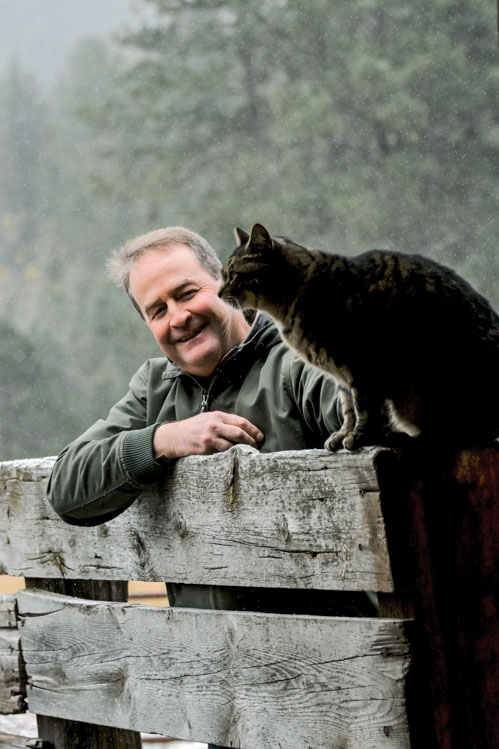
Nemo, he notes, is a Latin word for nobody, so it is a good place to contemplate his Bad River experience and convert it to art. The spacious studio, which they call Green Ink Gallery, is a remodeled horse barn. There are stalls for their two horses and hay mounds for a big tabby cat that shares the ranch with them, along with a German Shepherd they call Echo.

Most of the people who will see his paintings have never driven the Bad River Valley. He hopes to show them its natural shapes and curves, and its wild nature. “Sadly, there are subdivisions and cornfields and roads coming for it,” he says.

“We live on a sphere, and we’ve decided to cut it into squares. I view it as an imperiled landscape. Most of our prairie is already cut into squares, which seems like a crazy way of dealing with a landscape that’s anything but square.”

Editor’s Note: This story is revised from the May/June 2024 issue of South Dakota Magazine. To order a copy or to subscribe, call (800) 456-5117.

Posted on Leave a comment

The Light of Night

Can we save South Dakota’s dark skies?

Story by John Andrews

Photography by Christian Begeman

Fieldwork kept a teenaged Christian Begeman out after sunset, and he was walking the half mile back to the family ranch house. He had a flashlight to help navigate, but as darkness descended over Dewey and Ziebach counties a full moon rose high in the sky, and stars as bright as millions of tiny flashlights danced overhead. He didn’t need his battery-powered companion. “As my eyes grew accustomed to the darkness, I recognized that I could see a lot more than expected,” Begeman recalls. “The dips and ridges cast dark pools of shadows, which caused me pause to step into them. Then I realized it was the same path I already knew and soon I got up to nearly a full run without the aid of any light but the moon. It may have been a foolish thing to do in hindsight, but it was quite a rush.”

Diane Knutson, pictured with her husband Andrew and daughter Bridgette in the Badlands, is an advocate for preserving South Dakota’s dark skies. Photo by Steven Miller

Begeman fell in love with dark skies on that West River ranch and today spends his evenings photographing their beauty. The lesson he learned that night has become a main tenet among dark sky advocates today: the artificial light of ever-growing urban areas, oftentimes installed under the guise of improving safety and visibility, doesn’t always accomplish those tasks, and in turn, hampers our ability to appreciate the stars.

South Dakota boasts some of the darkest skies on Earth. Portions of the Black Hills National Forest and the Slim Buttes in Harding County are considered Class 1 locations on the Bortle Scale, a measure of night sky brightness developed by amateur astronomer John Bortle in 2001 that spans from 1 (the darkest) to 9 (inner city). Badlands National Park and several state recreation areas — located far from the lights of our biggest towns and cities — are Class 2.

Organizations like DarkSky International, founded in 1988, aim to slow the spread of light pollution. Diane Knutson is the association’s former president. Today, the Sioux Falls mother of two does volunteer work for the organization as a DarkSky Fellow. “The dark sky is best experienced rather than explained,” Knutson says. “It just kind of grabs hold of you.”

Knutson grew up in Dakota City, Nebraska, just across the Missouri River from Sioux City, Iowa, a city of nearly 90,000 people and a metro area encompassing nearly 150,000. Still, the urban glow didn’t hamper the love for stargazing that began in her backyard. “As a kid I would go outside and see the night sky, run around with fireflies and experience it in its natural state,” she says. “That drew me in, and I’ve always had that inkling to keep that relationship. The dark provides us an invitation to personal solitude, stillness, silence and reflection.”

But it’s disappearing. Knutson says light pollution is increasing about 10 percent a year, and the pace is quickening because of advancements in artificial light technology, such as the development of LEDs. “LEDs are great in some respects, but because they use less energy, we use them more. They are more accessible and not as expensive to use, so we don’t think as much about turning them off.”

Knutson says it’s important to remember that artificial light doesn’t simply stay where the switch is. When traveling east on Interstate 90, she can often spot the glow from Sioux Falls — our largest city at nearly 210,000 people — before reaching Mitchell. “Light pollution is easily solvable. There are so many issues that are big and hard to reverse, but light pollution can be reversed with the flip of a switch, or a timer, or just not using it. It costs less money, it helps our health, it helps our experiences and connections with each other. The night as a whole ties us all together because it stretches across time and space. We can connect with people who lived millennia ago because we each have that sky we can connect with.”

After decades of dark sky advocacy, Knutson thinks South Dakotans are beginning to understand light pollution and are taking steps to address it. Several years ago, Rapid City began celebrating Dark Sky Week in April with festivals, speakers and programs. A section of downtown streetlights is extinguished, a small nod to reducing the city’s skyglow. The Badlands Observatory in Quinn offers night programs and the public is invited to star parties during the summer months hosted by the Black Hills Astronomical Society at the Hidden Valley Observatory just off Hidden Valley Road northwest of Rapid City. Badlands National Park’s annual Astronomy Festival (July 18-20) includes star parties each night, activities during the day and a scale model solar system tour and walk.

Ralph Waldo Emerson once said, “If the stars should appear but one night every thousand years how man would marvel and stare.” Fortunately, the heavens are a wonderful, mysterious gift that unfold before our eyes every night — and nowhere more clearly than in the delightfully dark spaces of South Dakota.

Editor’s Note: This story is revised from the July/August 2025 issue of South Dakota Magazine. To order a copy or to subscribe, call (800) 456-5117.

Posted on Leave a comment

Singing the Blues in the Black Hills

Bobby Joe Holman has been to music’s proverbial mountaintop, and he believes he found its peak in South Dakota

By Bernie Hunhoff

BOBBY JOE HOLMAN’S face is weathered and whiskered. But it’s a fresh face to the Black Hills music scene and, as Muddy Waters would sing, Holman has his mojo working.

The country/blues artist has been entertaining audiences across the USA for most of his 76 years. He arrived in Rapid City in 2021 to be closer to his wife’s family. After playing in America’s bigger cities, some may wonder how he likes the small mountain towns of the Black Hills. Attend one of his gigs and you’ll hear the answer in every song.

“My heart and soul are happy,” says the Santa Claus look-alike who sometimes plays five or six nights a week in various venues throughout the Hills. “The body is giving out, but the mind is hanging together and I am at peace.”

Yes, that’s how Holman speaks — his sentences sound like verses to a Willie Nelson song, and these days the title could be “Lovin’ Life in South Dakota.”

Surrounded by military memorabilia, The Bobbys entertain at the VFW Club in downtown Rapid City.

Holman was born in the west Texas town of Seminole. He spent much of his childhood in southern California, where he strummed his first guitar. He was serving in the Navy, aboard a submarine during the Vietnam War, when he began a lifelong love affair with the harmonica.

 “I love the harmonica because it never sounds the same,” he says. “It almost plays itself. I start a tone and one note leads to another, it’s not all that structured stuff.” He started out with the diatonic harmonica, but soon grew to also love the chromatic, which has a wide range of notes.

After his military service, he studied music in Mississippi and became a successful blues singer, playing in Nashville and on Bourbon Street in New Orleans. He signed with Monument Records and found work in both radio and television.

He co-hosted a show called Across the Pond that featured U.S. and European jazz. Holman also became a successful author of “how to play” texts for the harmonica and taught the instrument at public schools, colleges, music stores and prisons. But commercial pursuits often interrupted his original love for a simple song.

“I’ve had a little bit of success,” Holman says of his career. “But the business end can suck you up. They’re always saying, ‘you should do this’ or ‘you have to do that.’ Now I don’t have to do anything but play the songs I love for people who want to hear them.”

Holman and his wife, Janet, came to Rapid City to live near Janet’s daughter, Genae, and her family. Genae’s husband is Bobby Sundby, a well-known local realtor and businessman. The two Bobbys became good friends, and soon they teamed up as a duo known, naturally, as The Bobbys.

“I needed a name I could remember,” Holman says with a laugh.

Bobby Sundby is well-versed in the Black Hills music scene. His brother, Johnny, is a notable photographer who plays music with a country-rock group called The Lonely Rangers. Their late father, John, was a popular Rapid City businessman and pilot who sang for decades with the Shrine of Democracy Chorus, a barbershop group.

“Our family has always been involved in music,” he says. “Our dad probably never said the word ‘gig,’ but he would love what we we’re doing and the way the music connects with people.”

Sundby says Holman is “one of the most upbeat, positive, encouraging and supportive human beings I’ve ever met. He’s opened up a new world to me, by encouraging me to play the guitar and sing. I started out playing drums at Augustana College. I love that I don’t have to haul the drums around anymore, but more importantly, it’s wonderful to grow as a musician.”

Sundby introduced Holman to the Black Hills. “When he married my mother-in-law, I heard about him playing in California. I didn’t know then how accomplished he was.  The first time I heard him sing, we were hanging out as a family in the kitchen when someone asked him to play the guitar.

“I happened to be playing gigs with Wild Bill Days in Deadwood, so I invited him to join in and he was great. He has a comfort level and a gift for gab that the audience loves, and as a musician  he has a rare quality. He likes to play a song a little different each time, and that makes it more fun and interesting for the musicians and the crowd. If he makes a mistake in front of people he’ll just laugh, and they like him all the more.”

Bobby Joe Holman is a fun-loving blend of Willie Nelson, Burl Ives and Ray Charles.

Sundby says Holman is a charming man, whether he’s having a private conversation or playing to a full house. “A friend of mine said he’s like a favorite grandpa that everyone loves.”

Holman laughs at such compliments. “Bobby likes to brag on me,” he says, “but the reward is all mine. And I couldn’t do this today without him.” He credits Sundby and South Dakotans as a whole for giving him a fresh start at his age, and he’s determined to learn all he can about the musical traditions of his new home.

He especially appreciates the band-friendly practices of the nightclubs that book The Bobbys. “Music-wise, there are a lot of events and venues, and they all try to pay you a fair wage here,” he says. “In Los Angeles, they treat you like a dog because they know that if you won’t do it there’s somebody else waiting in line.”

He also appreciates the cultural makeup of his new state. “I love that we have two cities, and all the rest are these little towns, and every town has its own soul, and the people have their own ways of seeing themselves. There is something beautiful about the way people get along here.”

Holman hopes to contribute the only way he knows — with his music. “I know I gotta stay healthy,” he says, “so I drink non-alcoholic beer. I love alcohol but it’s made me make a lot of really bad decisions. Now I practice every day and I learn new songs. I am blessed to have the dexterity and the voice to do what I love at this age.”

The Bobbys entertain at some of the Black Hills’ best-known venues and attractions, including the 1880 Train depot, Deadwood’s historic Landmark Casino, the Firehouse in downtown Rapid City and the Mount Rushmore KOA Resort, where they play outdoors on summer nights.

The Bobbys are still an unknown band to many in the Black Hills. They were booked to play at Terry Peak a few months ago when a typo in the advertisement listed them as The Boobys. “Every biker from a hundred miles around showed up,” Holman quips.

They also play at lesser-known places, including nursing homes where senior citizens in wheelchairs nod their heads to the blues. “The rest homes are such a rewarding experience,” Holman says. “Some of them are on their last roundup but you can see they are listening. The songs are touching them.”

He also likes to entertain at the VFW club on Main Street in Rapid City, where he banters with other veterans who mostly sit at the bar, far from the stage, but applaud every song. “I’m a proud lifetime member of the VFW, the Vietnam Veterans and the Sons of the American Revolution,” he says. “It’s a privilege to play there.”

Regardless of the venue or the demographics of his audience, Holman makes an impression. Sarah Smoke, who manages the 44 North Bar at the Baymont Inn in Sturgis, says The Bobbys have quickly become a crowd favorite. The blues music is amazing, she says, and Holman’s ability to connect with a roomful of strangers is rare. “He has a unique voice and he’s very skilled with the guitar and the harp, but it’s more than that,” Smoke says. “He is so comfortable with the music, and he creates an environment that is special and warm.”

Rural America never takes its musicians for granted because small town fans know a favorite singer or guitar player may be just one song away from leaving for the city. But Bobby Joe Holman came from the city. He’s been to the music world’s proverbial mountaintop, and now his only goal is to stay healthy and sing for the people of the Black Hills.

Editor’s Note: Readers can find upcoming gigs of Holman and Sundby on their Facebook page, which is titled The Bobbys: Two Guys, Two Guitars. This story is revised from the March/April 2025 issue of South Dakota Magazine. To order a copy or to subscribe, call (800) 456-5117.

Posted on Leave a comment

Yankton’s Downtown Strip

Yankton’s strip along the river has become a destination, and now the mall is re-opening. Is the town big enough for both?

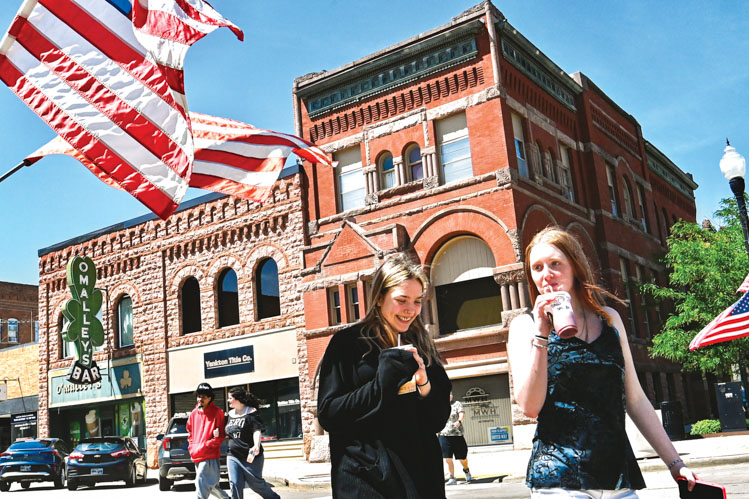
Yankton’s entire commercial district by the Missouri River is listed on the National Register of Historic Places, with 20 structures and landmarks. The corner of Third and Walnut (above) is considered the architectural core of the district.

By Bernie Hunhoff

Cathy Clatworthy remembers overhearing a customer who answered the phone while at the counter of her home décor shop in downtown Yankton.

“We’re doing The Strip!” laughed the customer.

Clatworthy says the customer explained, after ending the call with her husband, that it’s what she and her friends call a six-block stretch of stores and shops that parallel the Missouri River on the south edge of the old city.

“They love to walk from one end to the other and back,” she says. That would have been a short walk until the last few years because it seemed that mall shopping, big box stores, the COVID-19 pandemic and online shopping would end independent retailing forever. Forever, however, is short in today’s fast-changing economy.

A decade ago, Yankton still had JC Penney, K-Mart and other chain stores; most were in the Yankton Mall, 19 blocks north of the river. The riverfront seemed destined to become a financial district with a scattering of bars and antique shops.

“When the mall was really active, all the downtown retailers were just trying to get people to stop by the downtown stores when they were finished at the mall,” recalls Clatworthy. “I remember that we wanted to rent some display space in the mall to invite the shoppers to come downtown, but Dial Enterprises in Omaha, who then owned the mall, wouldn’t let us.”

Today, most of the retail giants are gone and small shops — including a big selection of clothing stores and a half-dozen stylish home furnishing shops — have opened in their wake. Every time a big box store closed, a few small shops popped up — mostly along Second and Third streets near the Missouri.                 

Cathy Clatworthy operates LilyCrest on Third Street.

Clatworthy traces the downtown district’s most recent resurgence to a community brainstorming session in 2017. Onward Yankton, a local nonprofit, recruited the state’s architectural community and Dakota Resources staff to meet with more than 100 Yankton activists. Together, they shared ideas and even made drawings of how the downtown area might look.                 

Locals agreed with the guest architects and designers that the town needed more downtown apartments, a sharper focus on historic preservation, better public gathering places and more shopping. Nothing happened overnight, but Clatworthy says all the goals are slowly being addressed.

Apartments and lofts above the storefronts are now home to hundreds of renters, and a new four-story apartment complex with 104 units called Gurney Flats just opened on the riverbank. Construction began in May on a seven-story loft that will alter the Yankton skyline.

Even the city’s once-sleepy bars have picked up the pace. Rock and country music bands entertain on weekend evenings in the variety of establishments, from the historic O’Malley’s and the Walnut (also dubbed the Dead Animal Bar because taxidermy mounts are the main décor) to newer places like Ben’s Brewing Company (a few blocks north of downtown) and the Boat House, a fun establishment with axe-throwing, music, darts and pizzas.

Onward Yankton members are raising money to restore the 1902 Dakota Theater. They even plan to reattach the theater’s unique, yellow 1940s Art Deco façade.

Kids and families love the splash pad near the foot of the historic Meridian Bridge.

The Black Steer, one of South Dakota’s oldest steakhouses, still serves filets and ribs, while several new eating establishments have opened — again, mostly within a block or two of the Missouri.

Today’s downtown entrepreneurs are scrappy. Clatworthy once had 20 antique vendors in her store. “Today’s generation doesn’t even want their own family heirlooms,” she laughs, so she refocused on picture framing, art and home furnishings. “I still keep a few antiques because they fit my building.”

Drew Delvaux and Zeke Matthews started an online furniture restoration business in 2017 and soon moved into a brick-and-mortar store called River City Relics, with a big selection of home décor, art and clothing. Sales were modest until they persuaded officials at lululemon, a fashionable apparel company, to join forces with them. “That’s a big brand that you won’t usually find in small towns and small stores,” Delvaux says. “But we kept working with them until it happened and it has been life-changing for us.”

Rita Houska stared selling jewelry and purses from the back of her father’s antique shop in 2007; she had her own store a year later. Today, she and her daughter Mandi stock two floors of surprises into one of Yankton’s many historic buildings. The basement ceiling is only 6 feet, 6 inches high, and the floor is wood planks, but no one minds because the inventory is one-of-a-kind, a blend of country and chic. You can buy everything from fine art and funky t-shirts to bread mixes that call for a can of beer and stylish cowhides ($275 for the biggest).

Carla Mueller runs Ninth Street Clothing on Second Street, near the scenic Riverside Field at Bob Tereshinski Stadium and its river view. She started the business in 2017 on Ninth Street at the edge of town (thus the name) and moved downtown in 2023 when she and her husband built a new building.

Carla Mueller (left) and Tracy Pravecek fashion summer hats at Ninth Street Clothing.

Mueller’s original location was an old, quaint building — like most of the independent stores in the neighborhood. She tried to incorporate some of that aura in the new store, with a vaulted ceiling and big windows that look out on the ballpark.

She loves the vibrancy of the downtown. “I can’t believe the number of young people who are going into business,” Mueller says. “They are invested in our community, and they are making it work. It’s a team thing. I love that it’s not a competition but a collaboration. If they can’t find something here, we point them to the other clothing stores, and I know they do the same.”

Ninth Street is the newest building and newest business downtown. The oldest is Boston Shoes to Boots, founded in 1915 and operated today by Mandi Gause and Brennan Ewald. The sisters bought the shoe store eight years ago. “Our dad pushed us into going in business for ourselves because he and Mom had worked demanding jobs, and always worked for ‘the man,’” says Mandi.

Their dad must be proud. Five years ago, they also bought a home décor store called Monta’s, renamed it Forte and have become young leaders of the loosely knit strip.

The downtown district also includes a small soap factory, an apothecary for holistic health, wedding venues, medicinal marijuana dispensaries, a ReStore shop run by local Habitat for Humanity volunteers and a new coffee shop called Muddy Mo’s, named for the ever-present river that flows a block away. (The coffee shop is operated by South Dakota Magazine.)

As downtown redevelopment happened, the Yankton Mall dwindled to near emptiness until 2023 when, ironically, a local entrepreneur named Matt Evans bought it from the giant Dial Enterprises of Omaha. Evans cleaned and aired out the cavernous mall, unlocked the doors and reopened the movie theater to much applause because it had been closed since the 2020 pandemic.

Evans has welcomed local shops, but he has 200,000 square feet to fill, so he is also recruiting chain stores. Thanks to support from the city commission — which has now voted twice to provide a sales tax rebate to assist with remodeling — Hobby Lobby, Five Below and Marshall’s plan to open before Christmas of 2025 and other announcements are expected.

In the 1980s, before the age of online shopping, there were more than 25,000 malls in the United States. Today there are only 1,000, and Capital One Research projects that the number could drop to 150 by 2032.

The Yankton Mall, and shopping centers like it, are now the underdogs of retailing. Meanwhile, Clatworthy and the other independent store owners are anxious to see whether a mall and a downtown can co-exist in a town of 15,000.

Neon lights still shine in Yankton, including at the historic Dakota Theater, built in 1902.

“It’s all unpredictable, we’ve learned that through the years,” she says. “There are fears based on past experiences and fear is dangerous. It’s natural but you don’t want to act on it. The chains are coming here because we have a market. Hopefully they do attract some new shoppers and if so then the market will grow for all of us.”

Carla Mueller of Ninth Street Clothing agrees. “We are all going to feel it initially when the big stores open, but then I think it’ll die down. In the end, they’ll bring new people to town and there will be two kinds of customers,” she says. “We are selling service as much as anything, and the bigger you get the harder it is to take care of the customer.”

Plus, Mueller says, it’s hard for a chain store or big box store to compete with the architecture, history and natural beauty of the river district.

Mandi Gause, the shoe store owner, agrees. “I believe we have one of the most beautiful backdrops a downtown could have, and it does make us unique.”

She’s also wondering about the return of the chain stores. “Early in our ownership, the previous owner told me there used to be several shoe stores downtown. I told him I was thankful that wasn’t the case anymore. His reply was blunt. ‘It’s better if there’s more competition because that means more people are in town looking for shoes.’”

That’s the very same optimistic and independent spirit that prompted Matt Evans to rehab an empty mall — and that shoppers seem to appreciate when they walk “The Strip” along the river. Yankton leaders are hoping that this time, everyone can coexist and grow together.

Editor’s Note: This story is revised from the July/August 2025 issue of South Dakota Magazine. To order a copy or to subscribe, call (800) 456-5117.

Posted on Leave a comment

Weekend Roundup!

Three ways to spend your weekend in South Dakota:

1. Honey Bee Festival at the Laurel Ridge Barn – Wedding & Events Venue in Sioux Falls, July 19. Sweet treats, live music and activities.

2. Farley Fest at Lake Farley Park in Milbank, July 19-20. Music, parade, cornhole tournament, inflatables, Q-Fest barbecue competition, art and food vendors.

3. Brulé at Outlaw Square in Deadwood, July 20. Free concert kicks off Deadwood’s Days of ’76 and is part of the historic mountain town’s 150th celebration.

For more events, visit www.southdakotamagazine.com/calendar-of-events

Posted on Leave a comment

A Celebration of South Dakota’s Diverse Cultures

Photos by Madelyn Glaze

We had a wonderful time at the 605 Unity Jam in Wagner. Something special about South Dakota is our pride of place and the celebration of the cultures that come together here; South Dakota really is a special place to be!

Check out our calendar of events for more fun festivals and gatherings!

Posted on Leave a comment

A Celebration of the Arts

Our July/August issue is out, and it’s packed with stories that celebrate our vibrant arts culture.

                  Written in collaboration with Arts South Dakota and the South Dakota Arts Council, this 148-page issue also serves as our annual South Dakota Arts Journal. Here’s some of what you’ll read inside:

  • This Land in 1776: Through Artists’ Eyes
  • Charlie Brave Heart’s Artistic Vision for Pine Ridge
  • There’s Something for Everyone at Custer’s Art Expressions
  • Printmaker Michael Baum Advocates for Wild Spaces
  • Fellowship Flourishes at Fleurish Flower Farm
  • How a Tragic Fire Reinvigorated Deborah Mitchell’s Art
  • James Van Nuys: Rapid City’s Man of Many Talents
  • Red Cloud’s New Chatku Arts Center
  • Photographer Cheryl Halsey Searches for Truth
  • Paul Horsted Shows Us South Dakota Yesterday and Today
  • Custer’s Hjem A.M. Delights the Eyes and Taste Buds
  • An Artistic Salute to the Barn
  • Plus Events, History, Travel Tips and Culture

Subscribe online or call (800) 456-5117 to start your subscription today!

Posted on Leave a comment

Weekend Roundup! Three Ways to Spend Your Weekend in South Dakota

1. Rooted: A Prairie Arts Weekend (July 10–12, Geddes) Head to the Missouri River region for this three-day celebration of art, music and place. Authentic Arts 605 in Geddes is hosting original art, workshops, demonstrations, wellness experiences, heritage stories, live music, food and prairie-inspired gathering spaces. A perfect weekend for slowing down and soaking in the landscape.  Our publisher, Katie, will be heading there tomorrow morning. Say hello if you see her!

2. Brookings Summer Arts Festival (July 11–12) Pioneer Park in Brookings comes alive with art, food, free entertainment, living history demonstrations, antiques and a dedicated kids’ area. A great family outing if you’re in the area this weekend.

3. Wall Celebration (July 9–11, Wall) The Wall Rodeo Arena is hosting a rodeo, concerts, a parade and kids’ activities for the annual Wall Celebration. It’s an authentic taste of a West River summer.

Check out our calendar of events for more fun festivals and gatherings!

Posted on Leave a comment

Black Hills in Bloom

Black Hills wildflowers are bursting with color. Spearfish photographer John Mitchell captured this gallery over the weekend.