

The Gift of South Dakota
Subscriptions to South Dakota Magazine make great gifts!
Subscribe today — 1 year (6 issues) is just $29!

If Our Trees Could Talk
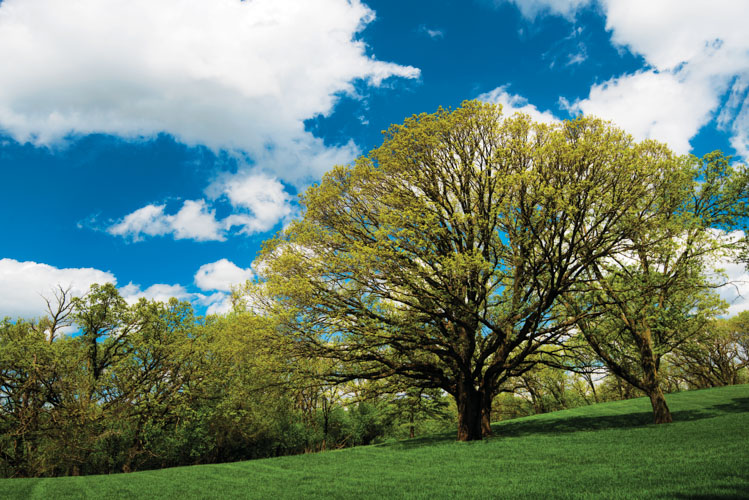 |
| A pair of oak trees known as the Twin Oaks are among the trees chronicled in Paul DeJong's book on the Sioux Falls urban forest. |
“Have you been here before?” asks Paul DeJong as we sit around a small conference table inside Touchmark at All Saints, a senior living community in one of Sioux Falls’ most historic buildings — the former All Saints School. The massive, four-story granite building in the heart of the city was finished in 1884 under the direction of William Hobart Hare, the first Episcopal bishop of South Dakota. The all-girls boarding school was designed to serve the daughters of missionaries who were serving the sparsely populated Dakota prairies.
But that’s not where this conversation is heading. “Some of the most majestic trees in the city are right outside,” DeJong says. “There’s a catalpa and a ginkgo tree on this property that were probably planted in the late 1800s or early 1900s.”
It stands to reason that the trees would be at least as old as the building itself, and of course DeJong would notice them. He worked at Landscape Garden Centers for more than 30 years, first as an employee and then its owner. He’s had a hand in selecting trees for nearly every neighborhood in Sioux Falls, an accomplishment made even more impressive considering the city’s rapid growth.
He seems to know every inch of soil beneath South Dakota’s sprawling metropolis. His quick and encyclopedic knowledge of trees allows him to tell you exactly why an American sycamore would thrive in one neighborhood but not another.
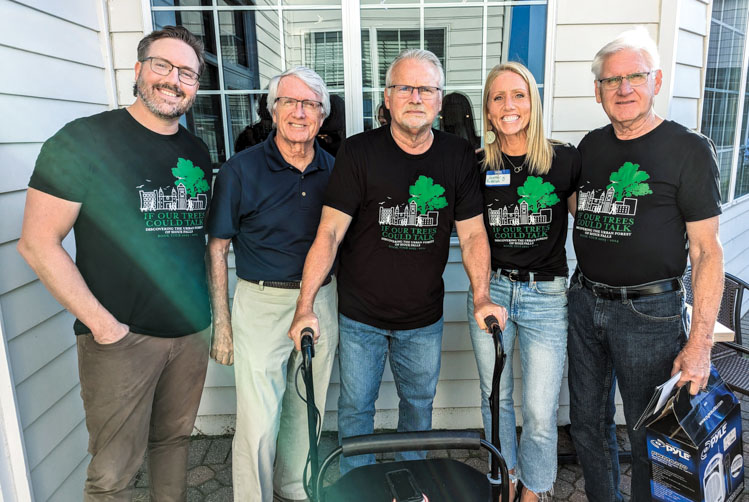 |
| The book publishing team includes (from left) Jeremy Brown, Paul Schiller, Paul DeJong, Heather Kittelson and Mike Cooper. |
The urban forest of Sioux Falls became his passion, and now, with help from friends, he’s finishing a book that he hopes will inspire future generations to appreciate the diversity of the city’s arbor culture. If Our Trees Could Talk: Discovering the Urban Forest of Sioux Falls is a 172-page coffee table book, completed in collaboration with the Mary Jo Wegner Arboretum, that traces the development of several historic Sioux Falls neighborhoods and the trees that give them life and character.
The idea for a book has been in the back of DeJong’s mind for at least 10 years, but it’s coming to fruition at perhaps the perfect moment. He was diagnosed with Parkinson’s Disease at age 53. He retired from ownership at Landscape Garden Centers in 2018, though he continued to work part-time until 2022. Eventually, he sold his home and moved to Touchmark.
The urgency of such a diagnosis led to the creation of a team to help make the book a reality. Heather Kittelson is the self-described “connector” of the team. She met DeJong in March of 2023, while both served on the board of directors for the Mary Jo Wegner Arboretum, a 155-acre greenspace tucked next to the Big Sioux River just off Highway 42 on the east side of the city. As she learned about DeJong’s health challenges (which included a serious car accident and a bite from a brown recluse spider earlier in life), she was inspired by his drive to persevere.
DeJong was equally impressed by Kittelson’s energy and positive attitude. She subsequently invited him to be a guest on her podcast called “Fortitude,” in which she interviews people who have overcome adversity. DeJong’s is among the most listened-to episodes.
After the podcast, Kittelson asked DeJong if he had any dreams he would like to see fulfilled. The answer was a book about the trees of Sioux Falls. “It really was a dream,” she says. “He just needed someone to help execute it. I love being resourceful and a connector, and I wanted to see Paul’s dream come to fruition.”
The rest of the team quickly formed. They include Mike Cooper, the arboretum’s executive director and a retired city planner for Sioux Falls; Jeremy Brown, the head of Throne Publishing; and well-known regional photographer Paul Schiller. Cooper and DeJong drove many miles around Sioux Falls, identifying neighborhoods and trees, and Schiller captured them throughout the year.
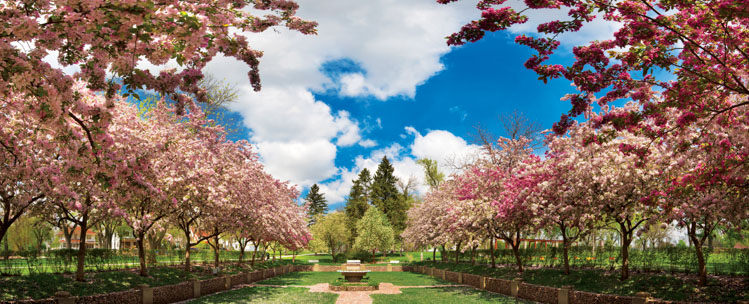 |
| McKennan Park in spring. |
DeJong wants the book to be an educational tool and hopes it will direct more attention to the arboretum. It could also be the culmination of a life devoted to the outdoors.
DeJong grew up on a farm between Sheldon and Hospers, Iowa. He got an associate degree in business and marketing from Northwest Iowa Community College and then headed to Sioux Falls, looking for opportunity. He stopped by Lakeland Nursery and noticed they were hiring. “Having grown up on the farm, I had a general knowledge of trees,” DeJong says. “They were taking applications and I needed money fast, so they said I could start working there the next day. I had no idea what I wanted to do, and in a couple weeks’ time I had found my passion working with trees, landscaping and outdoor living areas. You’re enhancing everybody’s opportunity to spend more time outdoors with their families as opposed to sitting in the house.”
He threw himself into the work, getting to know our native and non-native species and talking with both residential and commercial customers about the trees they wanted and the trees they needed — which were not always the same thing. DeJong is a huge advocate for tree diversity, and that can be challenging in South Dakota. “We can beat up on ourselves for not diversifying, but we are a prairie state with a mix of prairie grasses, so we’re limited in what species thrive here,” he says. “Trees weren’t necessarily by God’s hand meant to grow in South Dakota.”
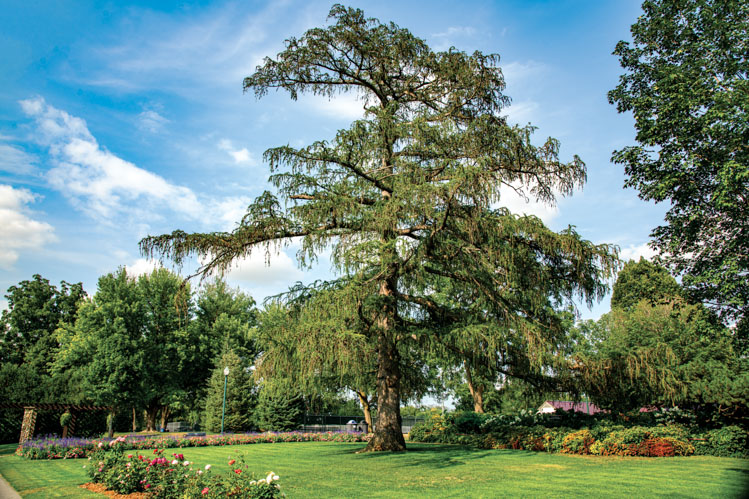 |
| An American larch in McKennan Park. |
When settlers first arrived in Dakota, they would have seen a nearly treeless landscape, other than the occasional willow, elm, ash, box elder and the cottonwoods growing in the river valleys. “Cottonwoods are so towering and large, and they’ll grow in wet, boggy areas,” DeJong says. “They could be several miles away and see these stands of cottonwood trees in the distance and know that there was likely water nearby.”
As railroads moved into Dakota, it became easier for those settlers from Europe or bigger eastern cities to order the trees they knew and loved. Maybe that’s how the catalpa and ginkgo trees ended up in DeJong’s new backyard. “Ginkgos are a very slow growing tree, but this one’s probably 80 feet tall,” he says. “They originated in China and are disease and pest resistant. They’re actually prehistoric trees. They’ve got fan-shaped leaves, very distinctive. The catalpa has a large plate sized leaf. It largely remains silent except one week in June when it gets a hydrangea-like flower. That’s its one week of glory for the year.”
One of DeJong’s favorite neighborhoods is McKennan Park, which is filled with historic homes and majestic trees. Among them is a big bur oak planted after World War I to honor the returning soldiers. It’s also home to the largest silver maple in the state and a stand of American larch. “When I was a kid, they quite often planted windbreaks with American larch,” DeJong says. “I didn’t realize what they were at the time. In the winter all the needles were gone, so I thought they were dead. But they come back in the spring and turn a brilliant golden color in the fall. Then in the winter they go dormant again. They’re mysterious or haunted looking trees.”
The American sycamore in McKennan Park is an example of being in the right place. “There are microclimates in Sioux Falls, like McKennan Park and the Cathedral District,” he says. “There’s good soil; it’s not only cold hardiness. You get on the edge of town where the winds are more abrasive, you’ve got about two inches of black dirt and the rest is excavation clay, and you’re more limited in what species you can use. I would never recommend an American sycamore anywhere other than the core area of the city.”
Other trees stand out for different reasons, such as a concolor fir in the Riverview Heights district north of the Veterans Administration hospital. “I would say it’s 100 feet tall. The first time I viewed that tree, a deer and a turkey came running out at the same time. I bet the bottom branches spread 40 to 50 feet across.”
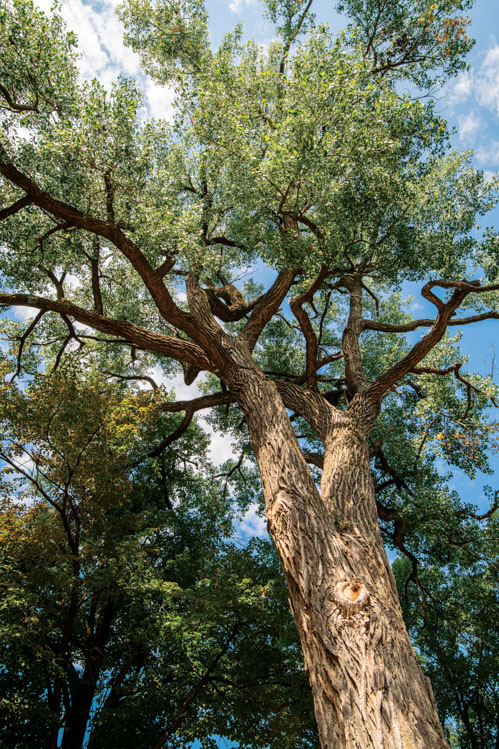 |
| A stately cottonwood at 57th and Minnesota. |
A cottonwood tree near Covell Lake is notable because its lowest branch is probably 50 feet off the ground. Another at the corner of 57th Street and Minnesota Avenue has been growing for more than 100 years and towers over other neighborhood trees. Black locusts in the Cathedral District shine in spring, when they blossom with droopy, lilac-colored flowers.
A stand of hackberries along South Cliff Avenue accents a neighborhood that began as a place for the city’s more affluent citizens to build second homes. A blue beech in the Maplewood District is rare for South Dakota. “It has very smooth bark and looks like an elephant’s leg because it flares out at the bottom. The smooth bark prevents insect infestation. If a tree has rough bark, it’s easier for insects to burrow into it, but the blue beech evolved over time. Trees are constantly under evolution. They’re just like human beings; they have to adapt.”
Everyone involved sees the book as a starting point that can lead to continuing education in K-12 classrooms and at the arboretum. DeJong envisions an “urban forest university” that encourages young people to get outdoors and learn about the trees surrounding them — not just because they might be pleasant to look at but because of their benefits for the environment and our health. “I spent a fair amount of time recovering from surgical procedures at the Mayo Clinic. I remember going through the gardens once I was able to get outside. The trees seemed to soothe my physical pain. It is true that trees reduce stress and promote physical and mental healing.”
Working with DeJong on the book has been rewarding for Cooper and Kittelson. “We’re all so busy going through life that we tend to forget how beautiful our surroundings are,” Kittelson says. “Paul has helped me to stop and be present and take in what’s around me.”
May we all slow down and learn to appreciate both the forest and the trees.
Editor’s Note: DeJong’s book is available from the Mary Jo Wegner Arboretum in Sioux Falls. This story is revised from the March/April 2024 issue of South Dakota Magazine. To order or to subscribe, call (800) 456-5117.




$29 for 1 Year |
 |

Comments