

The Gift of South Dakota
Subscriptions to South Dakota Magazine make great gifts!
Subscribe today — 1 year (6 issues) is just $29!

Living with Lions
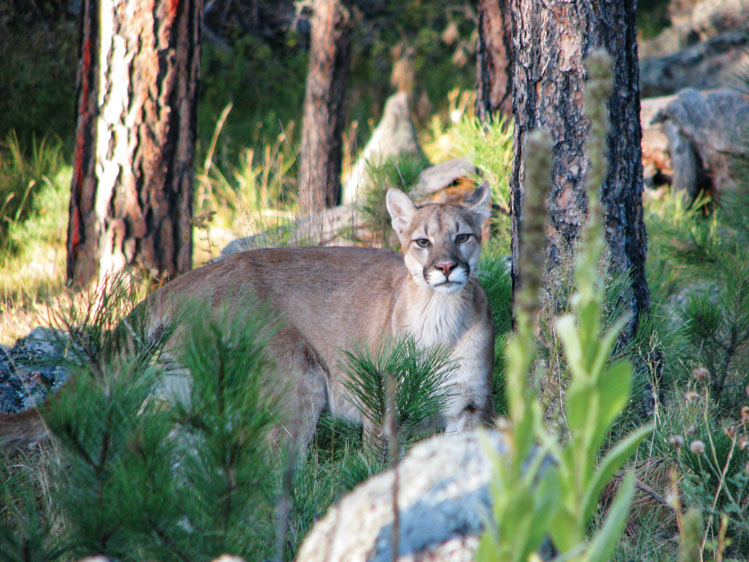 |
| Mountain lions, found from Chile to the Yukon Territory, are the most widely distributed wild, terrestrial mammal in the Western Hemisphere. Researchers estimate that between 200 and 300 mountain lions live in the Black Hills, though their secretive nature makes sightings rare in the wild. Photo by Sam Stukel |
REPORTS BEGAN COMING into Yankton police at 5:50 on a Monday morning in June of 2004. Two hours later, police and state Game, Fish and Parks Department officials had found a 115-pound mountain lion beneath a camper in a quiet neighborhood just east of the Yankton Middle School. Tranquilizing and relocating the big cat was not an option, so officers shot it in accordance with Game, Fish and Parks policy.
There was still a buzz about the mountain lion when we moved to town a year later. In fact, people talk about it today. Mountain lions live in the Black Hills, 400 miles away. One had never been seen in town. The only previous evidence of a lion nearby was a confirmed footprint found in Yankton County in 2002.
I thought about the excitement of that lion sighting when police congregated in my neighborhood in July of 2020. An officer said a mountain lion had been spotted just a few blocks away — captured on a home security camera sauntering between split-level homes — and was last seen heading east through a cornfield between the airport and my house.
Suddenly alert neighbors stood in driveways, hoping to catch a glimpse of our unusual visitor. I kept watch at the window for a flash of tan moving through the tall green cornstalks. But I think we all knew that the lion had slipped quietly into the country just as quickly as he had appeared.
Mountain lions still show up in Yankton, mostly on game cameras that are monitored by residents living along the forested river bluffs on the south edge of town. None have been shot since the 2004 incident.
Few animals in South Dakota seem to captivate us quite like the mountain lion. Fifteen years ago, Sam Stukel was hunting elk in the Black Hills when he suddenly noticed a young lion about 15 yards away. He captured a shaky video and posted it to YouTube, where the 75-second clip has amassed 232,000 views. “I still get email notifications every time someone comments on it,” says Stukel, who is also a photographer and a fisheries biologist at the Gavins Point National Fish Hatchery west of Yankton. “The variety of critiques is amusing. I’m an idiot for not being more afraid of the cat, or I’m a chicken for being so afraid of the cat. Everyone’s an expert on YouTube.”
Mountain lions are just as divisive offline. People like my Yankton neighbors are eager to someday see one in the wild, while others think one mountain lion is one too many. They are seen as both majestic creatures and vicious predators out to kill pets, livestock and maybe even humans. Reality is somewhere in the middle. Mountain lions lived in South Dakota long before people and have become an important part of our ecosystem. They are our neighbors, so we should get to know them.
*****
Jonathan Jenks and John Kanta are our state’s leading authorities on mountain lions. Jenks, a distinguished professor emeritus of wildlife science at South Dakota State University in Brookings, spent 17 years closely studying mountain lions in the Black Hills. Kanta is a terrestrial section chief for the South Dakota Department of Game, Fish and Parks based in Rapid City who has devoted nearly all of his 27 years with the agency to mountain lions.
Jenks began his research in 1998 when GF&P noticed an uptick in reports of mountain lion attacks. Livestock and horses on West River ranches and two mule deer within the Rapid City city limits were believed to have been killed by mountain lions. A year before, GF&P had estimated only 15 to 25 mountain lions lived in the Black Hills, but officials wanted to learn more. The agency partnered with SDSU and Jenks and his graduate students began capturing and radio collaring lions to establish a population estimate and learn about their lives, which date back millions of years on the continent.
The lions’ earliest ancestors likely migrated across the Bering land bridge into the Americas between 8 million and 8.5 million years ago. Mountain lions became recognizable as a distinct species about 400,000 years ago and roamed the continent alongside giant sloths, mammoths, dire wolves and saber-toothed lions.
Scientists believe the climate grew too cold for mountain lion populations to survive during the Pleistocene ice ages, but they later returned from more southern regions. They can be found from the southern tip of Chile to the Yukon Territory, making them the most widely distributed wild, terrestrial mammal in the Western Hemisphere.
As settlers populated the Upper Midwest in the 1800s, mountain lions became targeted as threats to livestock. The animals were hardly mentioned in the reconnaissance ahead of Lt. Col. George Custer’s 1874 expedition into the Black Hills. But the following year, Richard Irving Dodge, who had been with Custer’s men, accompanied geologist Walter Jenney back into the Hills. He noted mountain lion prints around their campsite. “He thought these lions were investigating the camp at night because they are nocturnal,” Jenks says. “They would approach the camp, probably mostly out of curiosity. As a result, Dodge called them cowards,” implying they wouldn’t come out when they could shoot them.
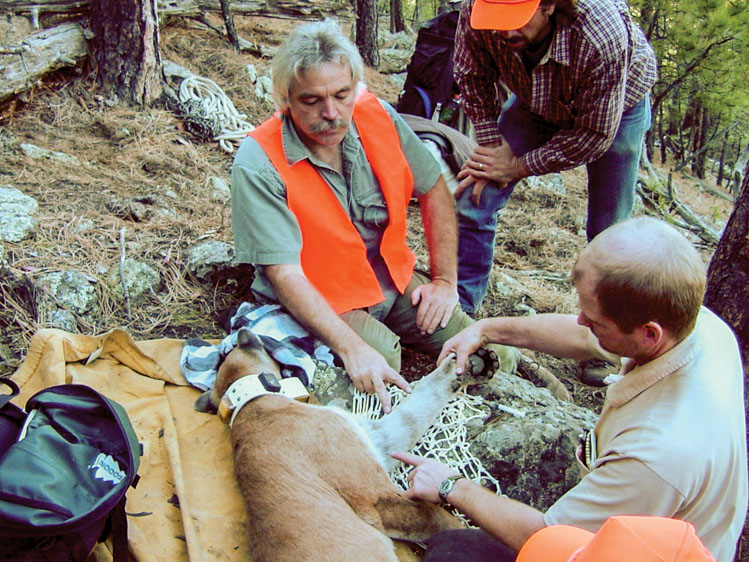 |
| South Dakota State University professor Jonathan Jenks and Steve Griffin of the state Game, Fish and Parks Department (in the foreground) collect information on the age of a mountain lion. |
In 1889 the South Dakota legislature placed a bounty on mountain lions, and by 1906 they were nearly extirpated. Sightings were scant for decades. A man named Earl Bedell killed one near the head of Stockade Creek in Wyoming in 1930. Ted Mann, who ranched near Dewey in southwestern Custer County, shot one in the early 1950s. Four were spotted in Wind Cave National Park in 1964 and 1965, and tracks were found west of Custer in 1965 and near Crow Peak in Lawrence County in 1968. No one could be sure if they lived in South Dakota or were transients. By 1978 all bounties were gone, and mountain lions were declared a state threatened species, which garnered legal protection.
That opened the door to recovery. Jenks and other researchers believe that lions from southeastern Wyoming followed northeasterly draws that effectively funneled them into the Hills. “That’s why when we first started studying them, it was easier to capture mountain lions in the southern Black Hills because there were potentially more of them there than in the northern Hills,” Jenks says. “It was right at the beginning of the recolonization of the Black Hills in the late 1990s.”
After a few years of research, Jenks and his team of graduate students estimated that 100 mountain lions lived in the Black Hills — far surpassing the GF&P estimate of 15 to 25 in the late 1990s. The animals were removed from the threatened species list and reclassified as a big game animal.
In 2005, GF&P announced the first experimental mountain lion hunting season with a limit of 12, no more than half female. It resulted in a lawsuit from the Mountain Lion Foundation of California and the Black Hills Mountain Lion Foundation, which sought an injunction to stop the harvest, arguing that there was still not enough known about the local population and that a hunting season could once again lead to regional extinction. A judge in Pierre ruled in favor of the state a week before the season was to open. A mountain lion season has continued every year beginning the day after Christmas and running through April. The season ends earlier if either 60 total mountain lions or 40 females have been harvested.
So began a delicate balance between those fascinated with the presence of mountain lions and those who want to hunt them. Kanta says between 3,000 and 5,000 licenses are sold for every season. “A lot of our mountain lion hunters are very dedicated and love that opportunity,” Kanta says. “I would also offer that there are a good number of folks who feel like this is a magnificent critter and would love that one-in-a-million chance to see a mountain lion out in the wild. They are intrigued by mountain lion tracks in the snow, or just knowing that they are out there.”
As mountain lions re-established themselves in the Black Hills, Jenks’ SDSU team and GF&P researchers like Kanta learned as much as they could. Adult males can be more than 8 feet long and weigh an average of 150 pounds. Adult females are around 6 ½ feet long and weigh 90 pounds. Adult males are generally solitary, while lions seen traveling together are usually a mother and her kittens, which stay together for 12 to 14 months.
Lions are solitary hunters that stalk their prey. They take advantage of thick vegetation or attack from upslope when they need a quick sprint. Lions have low endurance in chases, so targets that can run fast and long will likely escape. Older lions have better success rates because they learn the traits of other wildlife. Their preferred meal is deer, but Jenks learned that they are opportunistic, capturing whatever might be near, including rabbits and porcupines.
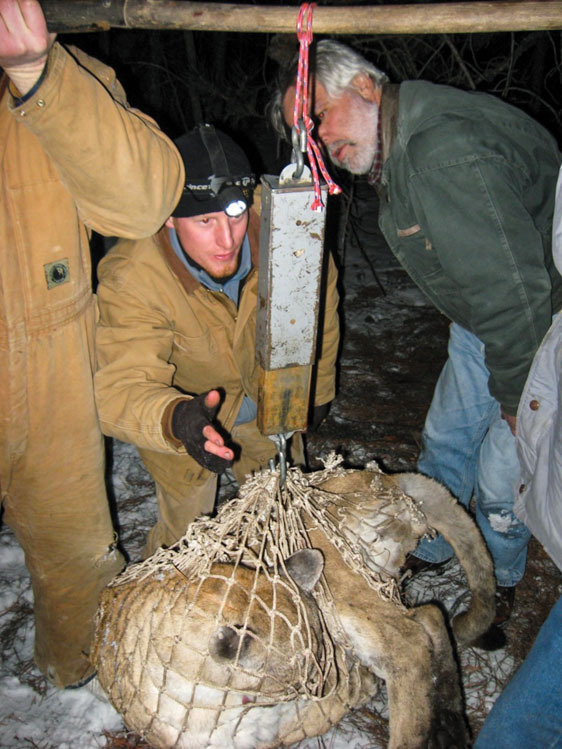 |
| A capture crew including Jenks and SDSU graduate student Brian Jansen determines the weight of a male mountain lion in Custer State Park. |
Mountain lions that show up East River and beyond most likely come from the Black Hills. Young males want to leave their home range and their mothers. “We did a lot of work on dispersal, trying to figure out where these cats were going,” Jenks says. “We followed them through North Dakota, northern Minnesota, the Niobrara River in Nebraska. There was one in Howard, one in Brookings. A 3- to 4-year-old male ended up about 8 miles south of Brookings, which was unusual to have a cat that age.”
In most instances — including the animals that wandered into Yankton — the mountain lions were simply passing through. They have no interest in interacting with people. “What they want to do is get away from you,” Jenks says. “It’s exciting to see them, and they are such an amazing animal, but they really just want to get away from you. In order for them to interact with you, there’s got to be some reason. A worst-case scenario might be standing on a hillside, and you slip into a den with kittens. In all the other situations that you can envision, lions are trying to avoid you. They might be climbing up a tree to let you go by, or running away from you, or staying quiet while you pass. That is borne out by looking at the number of negative interactions between people and mountain lions in the Black Hills. They are very few to nonexistent.”
As their familiarity with lions increased, it grew challenging to deal with public perceptions, which seem to be black and white. “There are two sides of the coin with mountain lions, and that’s what makes them interesting,” Jenks says. “You’ve got people who love them to death and people who hate their guts, and you’re trying to weave between the two to make everyone happy.”
That divide has a long history. The Cougar Hunt is a 1920s silent film created by the United States Department of Agriculture in which mountain lions are nature’s scourge slayed by noble hunters. “Predators of the range,” reads the opening slide before showing a lion lounging in a tree. “Uncontrolled predators exact a heavy annual toll of livestock and game,” reads the next slide, before shots of grazing cattle and sheep. Then, a group of men walking through the woods encounter an animal carcass covered with debris, “The work of that prince of predatory cats — the American lion, or cougar.” The film ends with a hunter shooting a treed lion. As it falls, the final slide reads “a ‘good’ lion at last.”
Others have admired the big cats. A mountain lion from Arizona named Josephine became the mascot of Theodore Roosevelt’s Rough Riders during the Spanish-American War. Roosevelt clearly respected lions. “It is itself a more skillful hunter than any human rival,” he said. “… It is a beast of stealth and rapine; its great velvet paws never make a sound, and it is always on watch whether for prey or for enemies, while it rarely leaves shelter even when it thinks itself safe.”
A student once asked Jenks if she could raise two cute mountain lion kittens In her home. “What happens when you’ve got a 150-pound mountain lion in your living room with your two small kids?” he asked.
During a GF&P commission meeting, after Jenks testified about the number of lions in the Black Hills, a local resident objected, saying there were many more and their numbers should be reduced. He believed he had seen the same mountain lion three different times near Hill City, and suggested lions were decimating the deer population. “It’s really tough to get by those perceptions, because mountain lions do kill deer,” Jenks says. “If you have a mountain lion, it has to be killing deer, and that’s the real simplistic vision of people with predators and prey. But there are a lot of other things going on in the Black Hills. Harvest, predators and disease make species management difficult, and mountain lions bear perhaps an unfair burden.”
Fear might even lie in the animal’s very name. Because of their wide dispersal and interactions with different subsets of American culture, they have assumed many monikers. In Florida they are panthers, in New England catamounts, for cat-of-the-mountain. Elsewhere, they are cougars or pumas. In South Dakota, they are lions, which conjures a very specific image. “When people hear lion,” Jenks says, “they think African lion.”
*****
Mountain lion numbers in the Black Hills ebb and flow. The GF&P’s current population objective is between 200 and 300, as established in the South Dakota Mountain Lion Action Plan, first written in 2010 and updated every five to 10 years. Kanta recalls one year when numbers surged, and his office fielded multiple reports of mountain lion sightings. “Anything that flashed by was a mountain lion and people would call us,” Kanta says. “Ninety percent of them were not legitimate, so you’d start to get a little complacent.”
One day he responded to a report of a mountain lion living in a garage. When he arrived, he found the garage door open about a foot. The homeowner explained that he had housecats and left food for them in the garage. “I’m standing right in front of this door, and I told him to go inside and push the button and let me take a look. As he opens it, a full-grown mountain lion comes running out and almost bumps into me. It turned out that the lion had been going inside the garage in pursuit of those cats.”
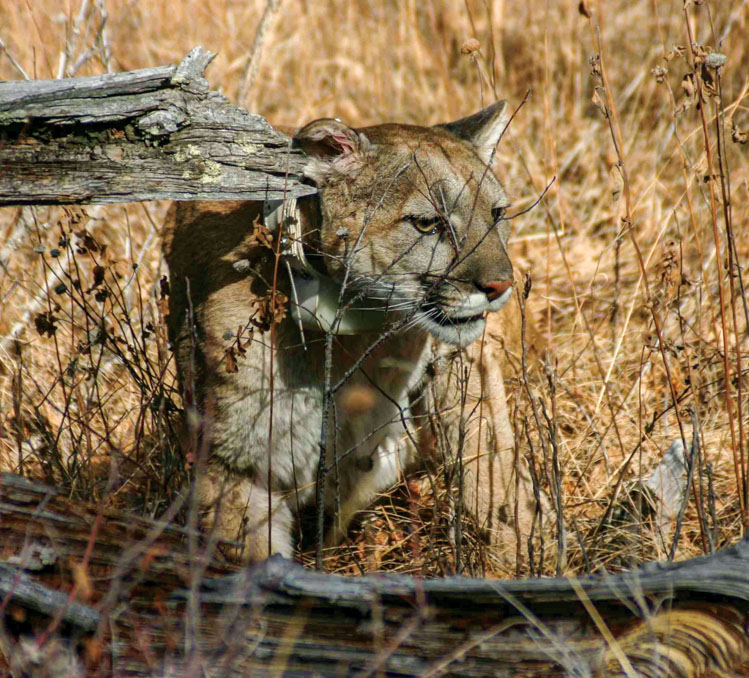 |
| Information collected on radio-collared mountain lions has confirmed dispersal from the Black Hills to Minnesota, Oklahoma, Nebraska, Wyoming and Saskatchewan. DNA from lions captured in the Black Hills has been linked to cats that have traveled to the Chicago area and central Connecticut. |
Mountain lions will take domestic animals. It’s one thing Jenks and Kanta want the public to know about living with big cats as neighbors. “If you have small children, you need to keep them close,” Jenks says. “If you have livestock or pets, you need to have them close. You need to watch if deer are spending a lot of time in your yard, because of the potential for drawing a cat in. And you need to know how to act if you encounter a cat. Act big. Don’t run. Yell at them. Show them that you’re not afraid of them and don’t act like prey, because there’s a chance that you might get attacked.
“We do need to learn to live with mountain lions, and that means people in South Dakota and the Black Hills have to take an active role in learning how to react when you see a mountain lion or if you’re going to recreate or live in mountain lion habitat.”
That may take time. Jenks is many years removed from actively working with mountain lions, but friends and neighbors in Brookings still call when they find suspicious tracks. “I never say that I don’t want to go out and look at it, because it very well could be a cat, and I’d be really interested if it was,” Jenks says. “People get excited.”
One recent winter, he was called to an area along Western Avenue on the west side of the city to examine tracks in the snow. He quickly realized it was something entirely different. “If you look at dog tracks, eventually you will find one that does not have nails and you can’t see the hind pad, so it looks like a lion print. I didn’t want to say this to the guy, but the reason he thought it was a cat print is because he was afraid of cats. And it was really just a dog that was walking along Western Avenue.”
Mountain lions are not fuzzy like bison (which can still be dangerous, as several visitors to South Dakota have discovered). They don’t have trophy antlers like elk and deer, or the uncanny ability to scale sheer rock faces like mountain goats or bighorn sheep. Yet they are mysterious, charismatic and — no matter if you’ve never seen one or have spent decades studying them — always captivating.
Editor’s Note: This story is revised from the January/February 2025 issue of South Dakota Magazine. To order a copy or to subscribe, call (800) 456-5117.




$29 for 1 Year |
 |

Comments