

The Gift of South Dakota
Subscriptions to South Dakota Magazine make great gifts!
Subscribe today — 1 year (6 issues) is just $29!

Milltown: After the Music Stopped
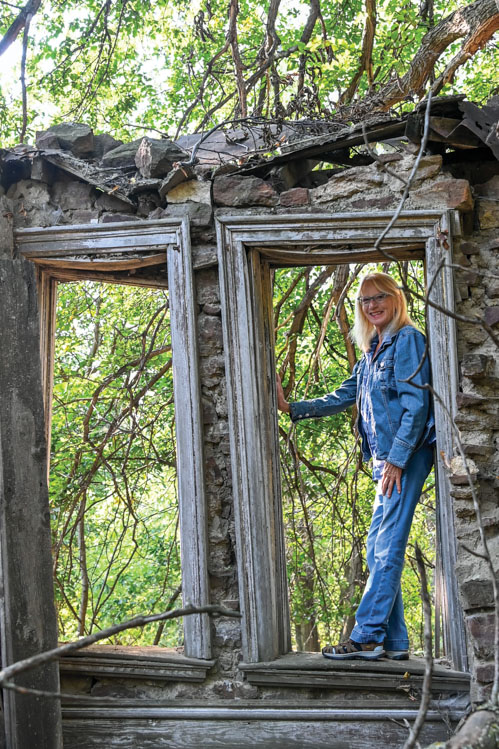 |
| Standing amid the stone ruins of her family homestead, Kay Adkins Brown preserves the stories of her ancestors who arrived in the James River Valley. |
When Kay Adkins Brown goes home to Milltown, she prays by the pasque flowers that bloom in April on the hillsides of the Jim River. On Mother’s Day, she sips brandy at her mother’s grave. She also keeps her eyes and ears peeled for stories and pictures because she has started a website to honor the history of northwest Hutchinson County and the once-thriving resort community of Milltown. “If our generation doesn’t record and preserve our history, it could all be lost forever,” she says.
Even before websites were possible, Brown was saving stories, pictures, recipes, historical letters and other artifacts of life along her stretch of the Jim River. “I have boxes and boxes of stuff,” she says. “Some of my elderly aunts had no children, and they gave me all their photographs and letters.” Her collection even includes a necklace that features a pearl plucked from the Jim River when clamming was a thriving industry there.
Every rural place deserves a champion like Brown. She was born and raised in Parkston, the largest town in Hutchinson County with a population of 1,670. Her parents, Pete and Margaret Adkins, were both raised on farms near Milltown, and she visited the community often as a child. Brown graduated from Parkston High in 1966 and then left for school and a career in education, but her love for the forested little island on the James River has only grown. Last autumn she agreed to guide us to some all-but-lost historical spots.
Our first stop was a stagecoach and pony express station. “We call it the Mattas Place because it was my maternal great-grandparents’ farm for many years,” Brown said. We found stone foundations and walls, surrounded and shaded by tall cottonwoods, elms and cedar. The James River, known locally as the Jim, flows placidly, about 200 yards downhill from the building site.
Hiram Bowen came from Wisconsin in 1877 and built a substantial two-story stone house. The front entrance served as a post office and stagecoach station. He called the place Martella, and perhaps envisioned it being a town someday.
Bowen discovered that a particular spot in the river was hard-packed with sand and gravel, which made it possible for wagons and horses to cross the muddy-bottom stream. Wagon ruts leading to the spot can still be found, though they are slowly succumbing to time and waist-high brome that has infiltrated the prairie grasses.
Joseph and Vincencia Mattas of Tabor bought the land for $4,500 in 1886. When they moved there, they were worried about highway robbers so they hid all their cash in the shirt of their infant son, George.
Brown knows many stories of the Mattas years. “George and his brother Steve were ice fishing one winter when George fell through the ice. Steve jumped in to save him. They survived but Steve was crippled from the near drowning.”
She says the Mattas family lived off the land, collecting chokecherries, fishing in the river, hunting and gardening. “They say Steve once caught a 75-pound catfish. It was so big he had to throw it over his back to bring it home,” Brown says.
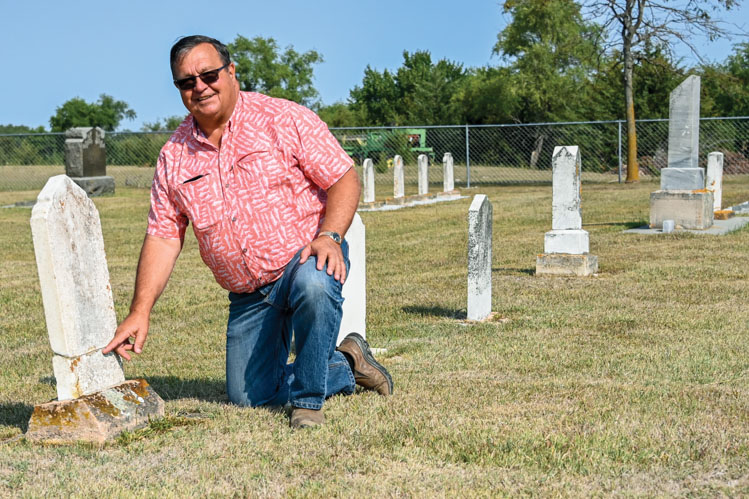 |
| Bill Hoffmann and other volunteers tend to the state's oldest non-denominational cemetery. |
A snake infestation drove the family from the old house. Bull snakes crawled up from the river and moved into the cracks in the mortar. Joseph and Vincencia kept a pair of pliers on the kitchen table to pull snakes out of the stones when they showed their heads or tails. Eventually they moved away, but in their senior years, George and his wife Grace (Kay’s aunt and uncle) returned in April as the pasque flowers bloomed. “Sometimes, as a child, I would go with Grace,” Brown says. They occasionally found arrowheads and tiny shark’s teeth.
“There was a large rock on a hill above the house that she called a praying rock. She would sit there and pray silently. Last year as I walked the hills I couldn’t find the rock, but I plan to look again.”
A few miles from the Mattas place, on the flat highlands above the river, lies Milltown Cemetery. Brown’s cousin Bill Hoffman is the head of the cemetery board. “I came here once and saw that the weeds were knee-high around my father’s grave, so I went to the next meeting to complain and I ended up with the job,” he laughs.
Now Hoffman chairs the board, running it with the precision you expect from a man who retired from a career with the South Dakota National Guard. When he renewed the cemetery’s lapsed nonprofit status, he discovered that it is the oldest non-denominational cemetery in South Dakota. Some graves date to the 1870s, but state records indicate the cemetery was officially established in 1884. It also ranks among the West’s best-kept rural cemeteries.
“Our first meeting of the year is called Mow Night,” Hoffman said. “On the third Thursday in May we all bring mowers and trimmers and get things ready for Memorial Day.”
A hundred or more people show up for the holiday observance. The Happy Memorial Band sings patriotic songs and someone gives a short speech. “My favorite is the rhubarb cake,” Hoffman says. “That’s rhubarb time, and someone always brings a good one. Everybody knows I will bring the lemonade and coffee.”
Hoffman hopes to build a picnic shelter and stone outhouse for the Memorial Day service, and for families who visit loved ones in the cemetery. He also wants to pour concrete bases for all the gravestones, old and new, to preserve them and to eliminate the need to trim around the stones. Brown would like to add bar codes to each gravestone that would connect visitors to online stories about each of the deceased.
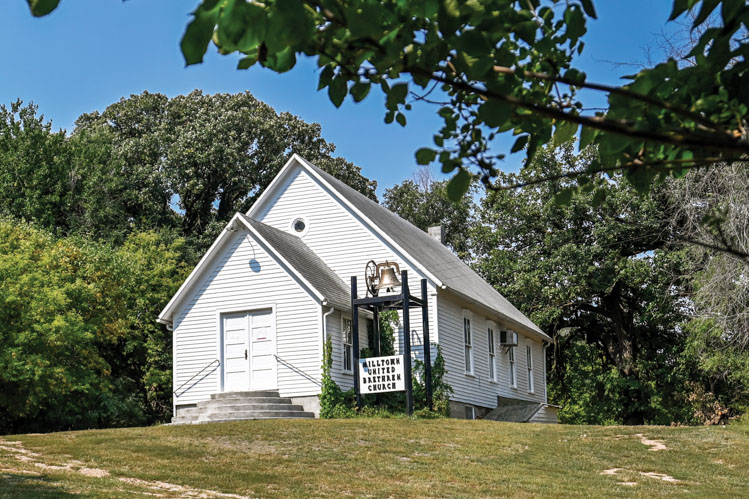 |
| South Dakota's last United Brethren Church still welcomes worshippers at Milltown. |
She and Hoffman know many of their stories. For example, Helen Adkins was a descendant of Mayflower pilgrims. Clarence Mize was killed by a train in Montana and Jethro Rardin was a Yankton saloon owner who tied the noose for the hanging of Jack McCall in 1877.
That sounds ambitious, but the cemetery has never been in better financial shape. Families of the buried have been helpful, and a major windfall arrived a few years ago from the estate of Keith and Eunice Welch. Keith Welch grew up at Milltown, moved away decades ago and lived in New Mexico and Colorado, but his grandparents are buried there. He was a distant cousin of Brown’s.
Even with a now-substantial endowment, the job of running a cemetery is demanding. “I want to have it set up so that 100 years from now, somebody will still be willing to take care of it,” Hoffman says.
“Five generations of my family are buried here,” says Brown. “They are the Mattases, Adkinses and Mizes. I bought a bunch of lots so all my people can be in the same place.”
A tiny gravestone for Ray Wulfing sits in a road ditch, just a few hundred yards from the cemetery gate. Ray was just 7, traveling west with his family, when he was struck by lightning and died. The tragedy happened before the cemetery was established, so the boy’s family erected a little marker on the prairie before resuming their journey. Decades later, the memorial stone was found in a plowed field and moved to the nearest fenceline where Hoffman and his friends tend to it today.
The cemetery is faring better than the town for which it is named. Milltown was a stagecoach stop in the 1860s that briefly gained prominence as the county seat of Armstrong County in 1873. However, the county was absorbed by Hutchinson in 1879. Seven years later, a Hutterite colony was established along the river.
The Hutterites built a flour mill powered by the river current, along with a grain elevator and numerous stone structures. However, anti-German sentiments drove the Milltown residents and colonies throughout South Dakota to immigrate to Canada in 1918. Today, the wood elevator and many of the stone buildings still stand, straight and solid, along the riverbank. A stone foundation that held the mill wheel is still visible in the riverbank.
Shortly after their exodus, the Hutterites sold land along on the west side of the river to E.J. Gray, who had a vision for a resort with cabins, boat docks and a grand ballroom. Island Park flourished for generations. Big-name entertainers like Lawrence Welk, Conway Twitty and Jerry Lee Lewis performed in the pavilion. Many southeast South Dakota youth partied and courted in the dance hall on Saturday nights. Revelers were always cautioned to be wary of the river, especially if they had too much to drink.
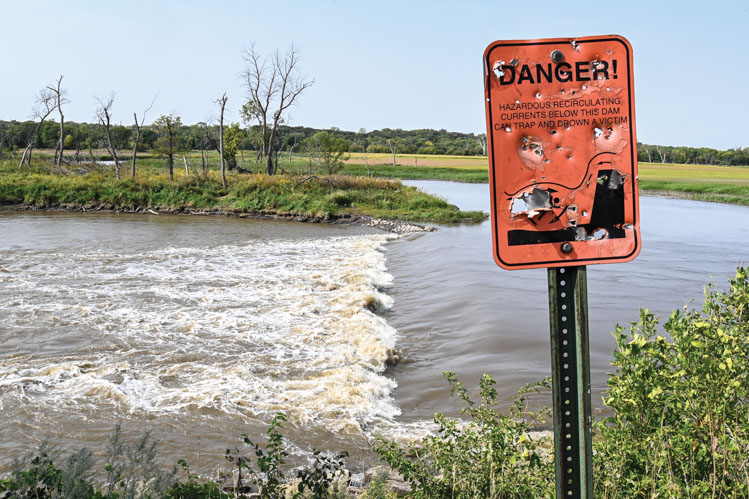 |
| Milltown Colony prospered until World War I, when anti-German sentiments caused the Hutterite families to leave for Canada. A dam and stone foundation remain on the Jim River where the namesake mill was established. |
Brown says her father was a deputy sheriff and local policeman who had a special outlook on the rough-and-rowdy dance hall. “Milltown was just a church and a dance hall back then,” she says. “Dad liked to joke that more souls were made in Milltown than saved in Milltown.”
However, the dancing and the music stopped in 1984 when a dam broke at nearby Lake Dimock, flooding the island and pavilion. Eventually the hall was demolished.
Ten years ago, Brown helped organize a nonprofit that purchased and modestly revived the park. Today, campers are welcome. Playground equipment has been erected and a boat dock is maintained for anglers. The nonprofit Island Park Foundation now holds summer car shows, outdoor dances and fishing contests.
The town’s United Brethren in Christ Church, built in 1880, survived the flood and still welcomes worshippers every Sunday morning. It’s the only United Brethren congregation remaining in South Dakota.
Brown says her extended family once owned 2,475 acres of land in Foster Township, which includes Milltown. “Some of them were descendants of people who came on the Mayflower,” she says. “Some came at the bottom of an immigrant ship from West Bohemia. Some migrated from Old Kentucky. They all had grandfathers who were in the Civil War, and some had ancestors in the Revolutionary War.”
Long ago, Brown’s grandmother Nellie Adkins wrote a poem lamenting the exodus of her Hutterite neighbors. She recently added it to the new website because the sentiments remain true not only for the colony but for all the changes that have come to the Jim River country in Hutchinson County.
I miss the old Russian colony, especially as
nightfall draws near
The old time sounds of industry are
Silenced, and minus the cheer
of homes and people that were happy
now tis empty and drear,
the old mill wheel stands idle and lonely
but the river still goes on its way
and no one knows if it misses the sounds
of that other day.
Editor’s Note: This story is revised from the January/February 2023 issue of South Dakota Magazine. To order a copy or to subscribe, call (800) 456-5117.


$29 for 1 Year |
 |

Comments