

The Gift of South Dakota
Subscriptions to South Dakota Magazine make great gifts!
Subscribe today — 1 year (6 issues) is just $29!

Scoping the Missouri
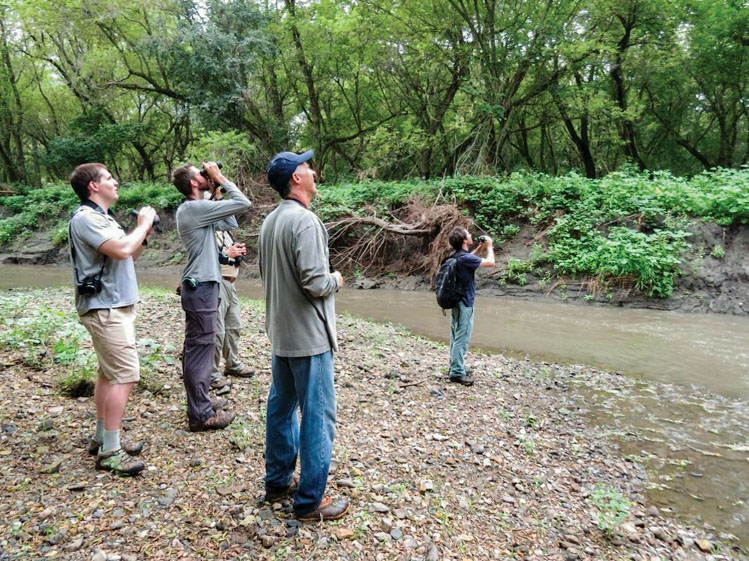 |
| Members of the South Dakota Ornithologists Union look for birds at Union Grove State Park between Beresford and Elk Point. |
Roger Dietrich was scoping along the shore of Lake Yankton when a Rapid City woman approached him with a question about the tiny Ross’s gull, which had been sighted in the area.
“I’ve gone to Alaska twice and I didn’t see the bird there,” she said. “Is it still around?”
Dietrich pointed to a gull, sitting on ice in the middle of the lake.
The Missouri River is a bird-watching paradise. Hundreds of species of ducks, geese, gulls, loons and other birds congregate in parks, woodlands and farm fields that border its 443-mile corridor. But it still helps to know for what you’re looking.
Every habitat attracts different birds, says David Swanson, professor of biology at the University of South Dakota and author of Birder’s Guide to South Dakota, and habitats vary dramatically along the Missouri as it winds from Nebraska to North Dakota.
Following is a guide, from south to north, of habitat patches and the surprises that await birdwatchers, both the serious birders looking for the rarest “lifer” bird and those who are happy spotting sparrows and swallows.
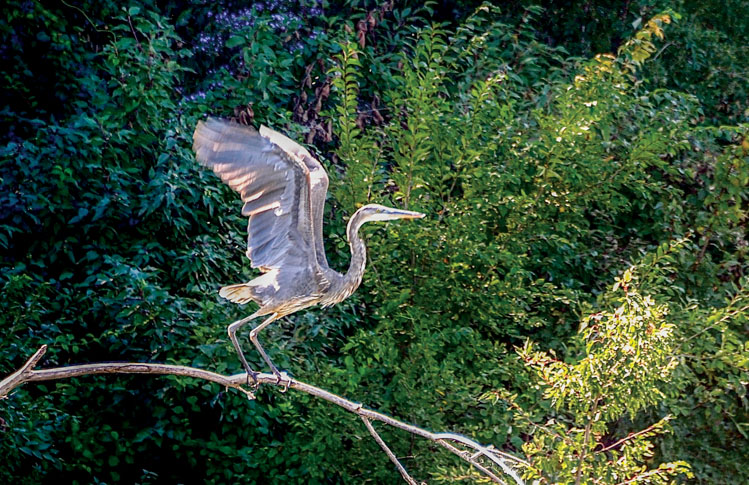 |
| The Adams Nature Preserve attracts wading birds such as blue herons. |
Adams Nature Preserve
Southeastern South Dakota
The Adams Homestead and Nature Preserve near North Sioux City includes many trails. “It has a variety of habitats,” Swanson says. “It has an extensive cottonwood forest that borders the river, and there’s also a little lake called Mud Lake that’s attractive to waterfowl. The ring of trees surrounding Mud Lake can be good for woodland birds, too.”
Mud Lake is approximately a quarter mile from the Adams Homestead parking lot, so a brief hike is required to access it. Wooden observation blinds lie along the trail with a view of the lake.
“The other habitat at the park is a restored open prairie,” he says. “It’s one of the few sites in the southeastern part of the state where you can find Eastern meadowlarks. The common meadowlark in South Dakota is the Western meadowlark, but the Eastern meadowlark is expanding its range in the southeastern part of the state and Adams Homestead is one of the places where you can find those.”
Since first being sighted in 2017 by Swanson and his ornithology students, the Eastern meadowlark has made regular appearances in the open-prairie habitat, often with multiple birds singing among the scattered trees.
“I wasn’t aware at the time that Eastern meadowlarks had started to expand their range, and I heard these Eastern meadowlarks calling,” Swanson says. “I go, ‘That is very unusual.’ We kept walking and saw them and everybody in the ornithology class got to see me geek out over it.”
Though birdwatching at the Adams Homestead is enjoyable year-round, it’s best in spring, summer and fall. “Mostly, it’s hiking the trails during migration and seeing a variety of birds at that time,” Swanson says. “It’s lots of warblers and sparrows, so the migration periods are late April to mid-May. Then in the fall, from mid-to-late August into about mid-September is probably the peak for warblers and vireos, some of which migrate all the way down to Central and South America.”
Sparrows that migrate to the southern U.S. and Mexico slightly later in the year can typically be seen at the Adams Homestead from mid-September to mid-October. Along the river and at the lake, birdwatchers encounter ducks and geese, as well as wading birds like herons and egrets.
“In the cottonwood forest, there are Eastern whippoorwills,” Swanson says. “Those are birds that don’t really get too much out of the southeastern part of the state. Of course, they’re nocturnal, so they don’t start calling until it starts to get dark.”
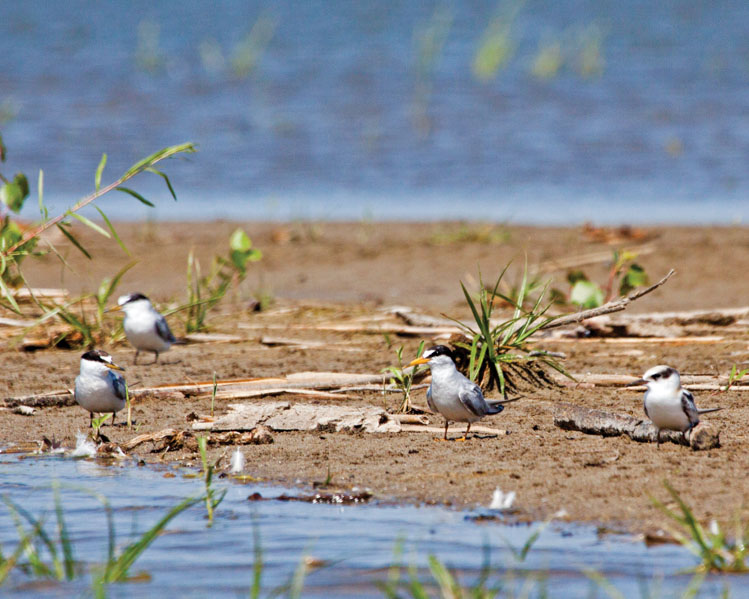 |
| Least terns can be found on sandbars below Gavins Point Dam. |
Gavins Point Dam
West of Yankton
Gavins Point Dam, the southernmost project on the Missouri’s system of six dams, is surrounded by unique bird habitats.
During the summer, hundreds of American white pelicans can sometimes be seen near the dam, while on the river itself, there are piping plovers, still considered a threatened species in most of the U.S., and the least tern, North America’s tiniest tern, often seen flying low over the river and hovering before plunging for prey.
“One of the reasons I like birding is the idea that it would be so cool to fly, and least terns are just the best flyers,” says Roger Dietrich, a local authority on ornithology. “They’ll fly and they’ll see a minnow, and then they dive straight down in the water — and splash!”
In winter, the 2-mile-long earthen dam creates an unusual condition for birds and birders. “Some years, when it doesn’t freeze, like lately, there’s been lots of open water above the dam,” Dietrich says. “Some years, we get lucky and even the Lewis and Clark Marina doesn’t freeze over real early. So, that’s a popular spot where some grebes and loons will stop.”
Black scoters, surf scoters, white-winged scoters and long-tail ducks, which are mainly ocean birds, are known to visit the lake and river in winter.
“I tell people from other places that we have those birds here and they’re just not believing it, because they don’t think of the center of the United States as a place where these birds would show up,” Dietrich says. “And when I say they show up every year, usually, for a fairly long period of time, they just can’t believe that we’re so lucky.”
The common loon migrates through the area, as well as a number of gulls — including Sabine’s gulls, kittiwakes, black-legged kittiwakes and even the Ross’s gull, which is associated with the remote arctic. Crest Road, which passes over the dam, is a good place to observe such birds. It requires no special pass or permit.
“Scan for the birds with binoculars or a spotting scope and chances are, you’ll find something different,” Dietrich says. “Sometimes there are huge flocks, and you can spend hours just scoping the birds there,” he says. “So, if you see somebody there with their scope out or binoculars, stop and ask them what they’re seeing. I’d say 99 percent of the people will be glad to point things out to you, and maybe even let you look through their scope to see what they’re seeing.”
Several snowy owls hung out along the dam road a few years ago. “They were feeding on the flocks of coots that were there.” Wintertime also brings large flocks of lesser scaup, which birdwatchers will scan for specimens of greater scaup, a polar bird that tends to prefer saltwater and is rarely seen inland, Dietrich says.
“It’s the same with the big flocks of common goldeneye,” he says. “People try to scope out the Barrow’s goldeneye, which is another species. It’s more of a West Coast bird, but once in a while, we’ll get one here — always a highlight.”
Bald eagles frequent Gavins Point Dam and some now nest year-round in the tall cottonwoods that border the Missouri. “They’re used to a lot of people around and some of the trees they perch in are right along the local roads,” Dietrich says. “You can see them in action, swooping down and picking up fish. I’ve seen eight or nine at a time on the ice up above the dam, eating the dead snow geese they’ve picked off.”
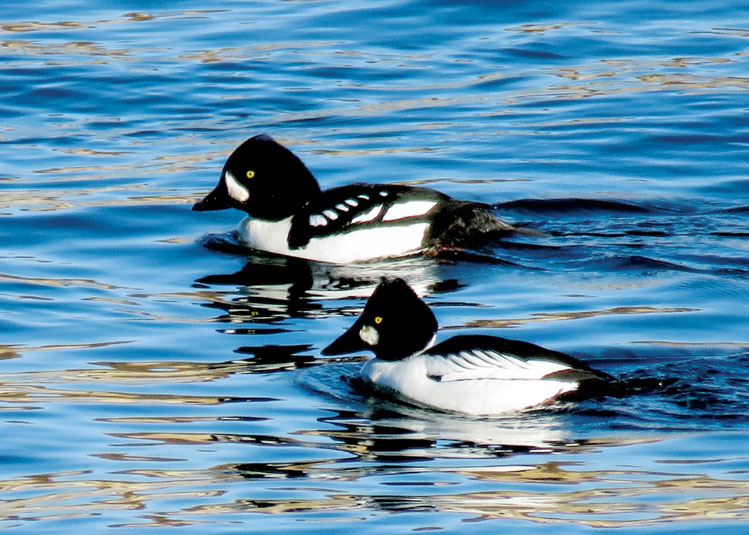 |
| A pair of Barrow's Goldeneyes at Fort Randall. |
Fort Randall
Pickstown
Fort Randall Dam also hosts a large congregation of bald eagles. Below the dam is the Karl E. Mundt National Wildlife Refuge, which provides habitat for the eagles.
Kelly Preheim, a kindergarten teacher in Armour and a well-known local birding enthusiast, especially likes the wooded area around the Fort Randall Dam. “We’re mostly on agricultural grassland in southeastern South Dakota,” she says. “But the dams have a lot of woodland, forested areas, and I enjoy walking on the trails.”
She found 71 bird species on a recent camping trip to Pickstown. “In the morning, oh my goodness, the singing,” she recalls. “My husband’s like, ‘I can’t get any sleep. It’s so loud here!’”
A hike to the tailrace, the channel below the dam that carries water away, will often be rewarded. “Fish that go through the dam come out somewhat stunned in the tailrace,” Preheim says. “Then, all these birds, like gulls and eagles and certain ducks, eat those fish.”
Like nearby Gavins Point, Fort Randall Dam is also home to many types of waterfowl in autumn and winter. “There are a lot of different ducks on the scene, hundreds and hundreds, if not thousands, of different ducks there at a time,” Preheim says. “I saw a brown pelican one time. That’s actually an ocean bird.”
Other surprise visitors at Fort Randall include a yellow-billed loon, typically associated with Alaska and America’s western coast, and a great black-backed gull, which is an Atlantic coastal bird, Preheim says.
Scarlet tanagers are often found in South Dakota but summer tanagers, a rare visitor, might also be seen around Fort Randall.
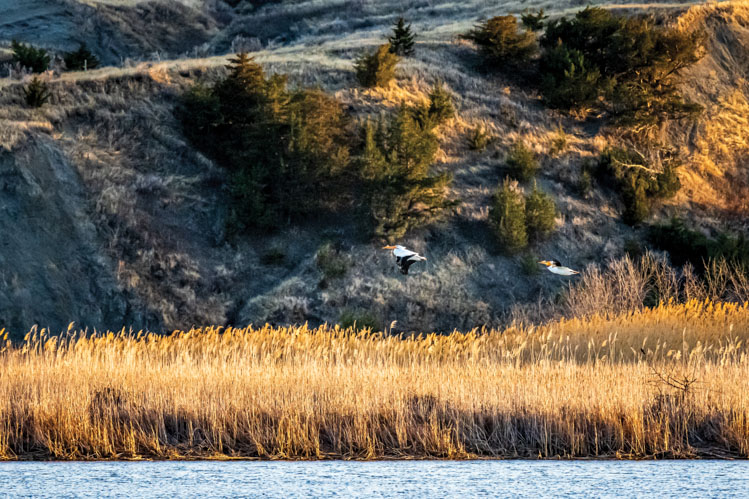 |
| Pelicans near Big Bend. |
Big Bend Dam
Fort Thompson
The best birdwatching at South Dakota’s northernmost dams — Big Bend and Oahe — occurs from April through May and from September to November, according to lifelong birdwatcher Ricky Olson, who lives at Fort Pierre.
Big Bend has fewer access roads and trail amenities than Oahe and the other dams, but it has its own charms. Ospreys nest below the dam and brown pelicans have been spotted.
“Once in a while, in the wintertime, you get a Brant goose at Big Bend,” a seacoast bird. “I run down to Big Bend at least every two weeks in the winter to see what’s there,” Olson says.
Big Bend also attracts smaller goose species, including snow geese and white-fronted geese, both of which are common to the area. “In the fall, it’s neater to go to Big Bend,” Olson says. “Also, the shad and minnow species will be in the shallows then, and you’ll get all kinds of cormorants and pelicans and hundreds of gulls in these frenzies where they’re all feeding, and the gulls are trying to steal from everybody.”
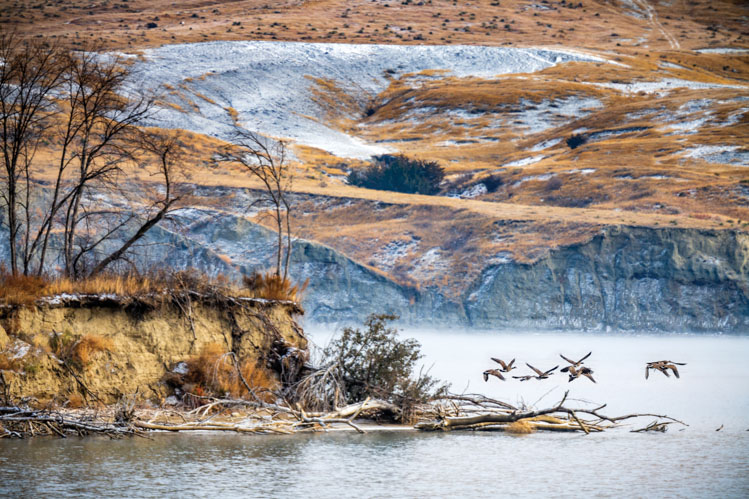 |
| Canada geese along the Missouri River. |
Oahe Dam
Central South Dakota
Ring-billed gulls, herring gulls and California gulls may be sighted at Oahe, as well as the arctic tern, a mega-find for birders.
A spectacle occurs during flooding when Oahe Dam’s hydraulic turbines are running. “It’s a feeding frenzy. You get thousands of gulls, maybe 20,000, below the tailrace in a half-mile stretch,” Olson says. “It’s like a snowstorm. Thousands of people come to watch the ‘gull snowfall.’”
Oahe also has cliff-dwellers. “In the sand layers in the cliffs, in the holes, there are barn owls nesting,” Olson says. “They dig their own holes, and often, they’re near where colonies of bank swallows have dug holes.”
In autumn, Sabine’s gull may be spotted. “It’s very pretty. It’s black and white with half a diamond on the wing,” Olson says. “We also get Bonapartes and Little gulls, which is a little gull, and we get some of the big ones. Once in a great while we get the great black-back, which is the biggest gull.”
Gulls breed on a few islands along Oahe, Olson says. “There are only a few places in South Dakota where that happens.”
Another rare visitor to Oahe, among the sea ducks like the scoters and the long tail duck, is the occasional coastal harlequin duck in the tailrace.
“We get loons,” Olson says. “Sometimes we get the Pacific or the yellow-billed or red-throated loon, which are rare for our state.”
Further north on Oahe, retired biology teacher Stan Mack says opportunities are available even in Mobridge’s city limits. “There’s a walking trail along the south side of town. Just follow Main Street to the river and walk west and you’ll see the ducks and geese and gulls that sit on the water.”
Mack says Indian Creek (east of Mobridge) and Indian Memorial (across the river to the west) offer trails and habitat.
Mack doesn’t walk well enough to explore like he once did, but the birds will come to him. “I’m doing a feeder watch for Cornell University. Right now, I’m looking at a collared dove — we never saw them before — and I see about 16 more picking up seeds on the ground.”
Editor’s Note: This story is revised from the March/April 2025 issue of South Dakota Magazine. To order a copy or to subscribe, call (800) 456-5117.
$29 for 1 Year |
 |

Comments