
The Gift of South Dakota
Subscriptions to South Dakota Magazine make great gifts!
Subscribe today — 1 year (6 issues) is just $29!

The Modern Rewards of Quilting
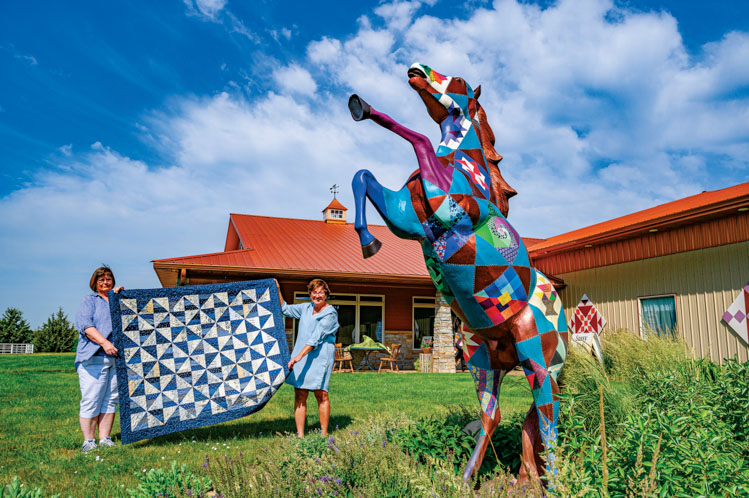 |
| Mary Kirschenman (left) and Sally Schroeder guide quilters at Sassy Cat Quilting, headquartered in a former horse barn north of Yankton. |
April Flying Hawk began quilting after her son, Ethan, died at the age of 3.
“I wanted to do a giveaway when my son passed,” Flying Hawk says. “And, I wanted to do the quilts myself, not buy them from anyone.”
Flying Hawk, a Wagner native and a member of the Yankton Sioux Tribe, reached out to the women in her community who create star quilts. Each of those women quilted differently. She took what she could from each quilter and began sewing, developing a process that worked for her. Now, Flying Hawk hand-stitches all her quilts to finish them. She only uses a sewing machine for the initial work of piecing them together.
Quilting feels like second nature for Flying Hawk. “The intention and goal of starting this was to find healing. It’s now become my second job.”
Quilting is growing across South Dakota. Shops catering to the quilters are especially showing up on main streets in rural communities. The reasons for the resurgence are as many as the stitches in a square.
Sally Schroeder’s shop, Sassy Cat Quilting, is located in a spacious, remodeled horse barn north of Yankton. She believes quilting is rooted in joy and passion. She also learned that it seams friendships.
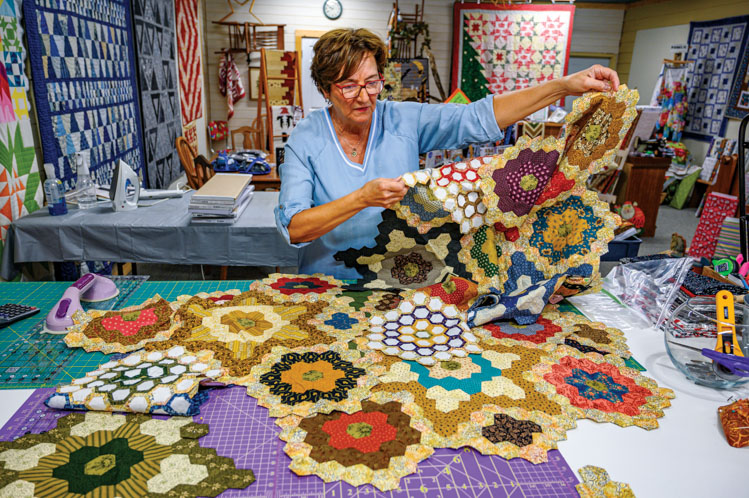 |
| Sally Schroeder's Sassy Cat Quilting north of Yankton is one of nearly three dozen shops that cater to quilters in the state. |
When Schroeder’s husband, John, was diagnosed with cancer a few years ago, she did not know how she would keep the business going. “My posse pitched in and helped me keep the doors open,” she says. The posse consists of family, friends and customers who share her love of quality. Fortunately, the fledgling business and her husband both survived the ordeal. Today, carloads of quilters make daytrips to Sassy Cat to learn the latest techniques or shop for fabrics.
When you hear the stories of quilting communities, the question of why people stitch and stitch and stitch is less mysterious. This is not a solitary craft.
Susan Sanders is the chair of marketing and advertising for the popular Hill City Quilt Show. “My sister has told me that quilting is like breadmaking,” Sanders says. “You take perfectly good ingredients and tear them up to make something new.”
Quilting is a thriving pastime in Hill City. The mountain town of less than 1,000 people has five stores dedicated to fabrics, notions and quilting. Hill City has also hosted an annual quilt show for the past 25 years.
“There’s definitely demand,” Sanders says. “If one business closes, another quickly opens up.”
Craft Industry Alliance data lends support to Sanders’ statement. This national community for craft professionals predicts that the nationwide quilting industry, which currently stands at $4.2 billion, will become a $5 billion industry by 2027. Though no one has an exact count, there are at least three dozen quilt shops in all regions of South Dakota.
Enthusiasm and love for quilting can span generations. Grandmothers and mothers pass down their knowledge and skills and foster important family relationships.
“I was born into quilting,” says Yvonne Hollenbeck, whose family ranches west of Winner in Tripp County. “I’m a fifth-generation quilter, starting with my great-great-grandmother.”
Hollenbeck is also a quilt historian. Traveling the Plains and Upper Midwest, she conducts educational programs on the history of quilting and teaches would-be quilters the basics. A writer and cowgirl poet, she has an entertaining style and a love for rural America’s arts and crafts.
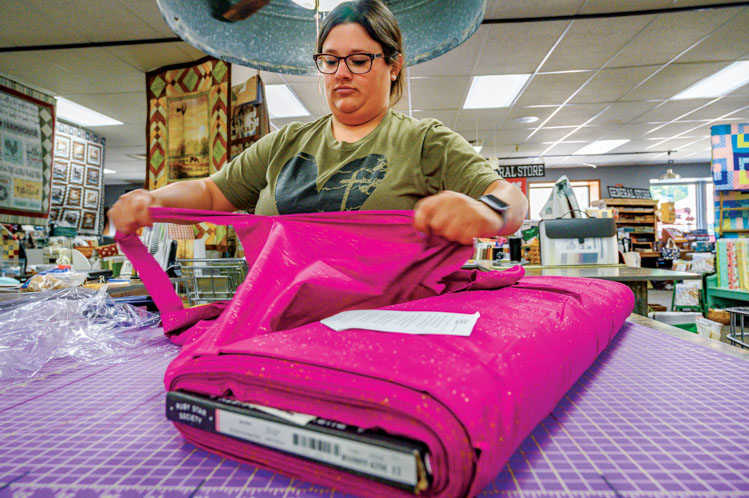 |
| Mariah Baumberger cuts fabric in her mother's store, Always Your Design, an anchor of the business district in Dell Rapids. |
“Amazon wasn’t available 150 years ago,” Hollenbeck says. “Quilts were made out of old clothing and scraps to keep the family warm. People lived in sod houses or shacks and houses were cold. Quilts were a necessity to everyone.”
Hollenbeck starts her education programs with a history of the Civil War and her own family’s roots in Franklin County, Iowa.
“Every soldier leaving Franklin County for the war had a quilt in their issue made by the local women’s guild,” Hollenbeck says. “Men were also issued a ‘housewife,’ which was a sewing kit, and the men learned to sew – uniforms and even wounds. Lint was used to repair wounds.”
While economic data suggests that quilting might be an expensive endeavor, Hollenbeck disagrees. She tells would-be quilters that the hobby doesn’t have to be spendy. Hollenbeck frequents second-hand stores to purchase goods that have quilting potential. She recycles worn-out clothing into quilts. And, she does not use a sewing machine. Every stitch is fingered.
“I find sewing by hand relaxing,” Hollenbeck says. “I keep a quilting kit in my purse. While I’m waiting at a doctor’s appointment or the airport, I take out the kit and piece. Once I get the quilt made, it becomes a member of the family.”
Lake Andes librarian Mary Jo Parker is working to broaden the appeal of quilting in her community. Parker launched a quilt-making project in the fall. It began with an inquiry to the library from the Public Library Innovation Exchange (PLIX), sponsored by the Massachusetts Institute of Technology.
“Our local school has no FACS [Family and Consumer Science]. The art teacher does a little bit with quilting, but it’s limited,” Parker says. “And, math is more than adding and subtracting.”
Parker believes that all youth — Native American, white and others — can benefit from understanding the symbolism of the Lakota star quilt, which has become a powerful cultural art piece in South Dakota.
Through the Lake Andes project, people of all ages will learn to construct star wall hangings or pillow tops. Community members will also be invited to work together to construct a 58-by-58-inch star quilt wall hanging for the library, using the colors of the Lakota Medicine Wheel (black, red, yellow and white).
Quilting has an emotional appeal, but it’s also good for rural main streets. Earleene Kellogg of Edgemont saw quilting as a way to go into business with family members. Kellogg, her husband Jerry and daughter Natalie, started Nuts and Bolts in Edgemont in 2005. Located in an old bank building, half of the business was devoted to quilting and the other half to motorcycle repair.
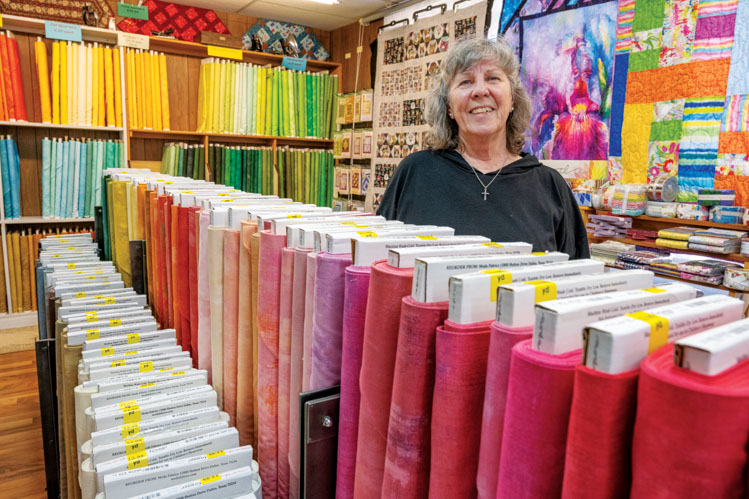 |
| Earleene Kellogg and her husband Jerry started Nuts and Bolts as a quilt shop and motorcycle repair business in Edgemont, but the quilting half eventually took over. |
“We started in the old bank building because it really lent itself to the quilting side of the business,” Kellogg says. “We’re on the edge of nowhere, so we draw people from Wyoming and Nebraska and southern South Dakota.”
The business has evolved in 19 years. Quilting is strong, but the motorcycle department never grew.
“We both rode motorcycles and we thought there would be a bigger market for that,” Kellogg says. When Jerry retired from the railroad, he began to do sewing machine cleaning and repair. He cleans and repairs long-arm quilting machines and treadle sewing machines. Business is booming without a Harley or a Honda in the shop.
Quilting can also be a lesson in mindfulness. Kathy Grovenburg, sales associate with Always Your Design Quilt Shop in Dell Rapids, says she quilts for mental clarity. “It’s my god time. I like the creativity, the art and challenge of making something work and come out right. It’s great for keeping your mind alert.”
Grovenburg has been quilting for 20 years. “I do one thing at a time and only focus on that step. When I’m squaring out my fabric, that’s what I focus on. When I’m cutting, I make sure everything is exact. I can’t think of anything else in those moments. People are hesitant to try quilting for a variety of reasons. If they tell me they’d like to but they’ve never tried it, I say just try it. If they say they don’t know how to quilt, I say we’ve got classes for that. If they say they’re not good at color, I tell them we have people who can help them with that. If they don’t have a sewing machine, we can fix that.”
Our ancestors sewed out of necessity. They wanted warm blankets. Today, quilting attracts people for myriad other reasons – passion, healing, mathematics, business and art. Grovenburg recommends that newcomers to the craft consider their goals.
Blankets are now a side benefit; the other rewards are just as heart-warming.
Editor’s Note: This story is revised from the November/December 2024 issue of South Dakota Magazine. To order a copy or to subscribe, call (800) 456-5117.





Comments
Enjoyed your video. Be safe. I’m in Tx. Bullard. HAPPY NEW YEAR.🥳🍪🤎✝️