

The Gift of South Dakota
Subscriptions to South Dakota Magazine make great gifts!
Subscribe today — 1 year (6 issues) is just $29!

Winyan
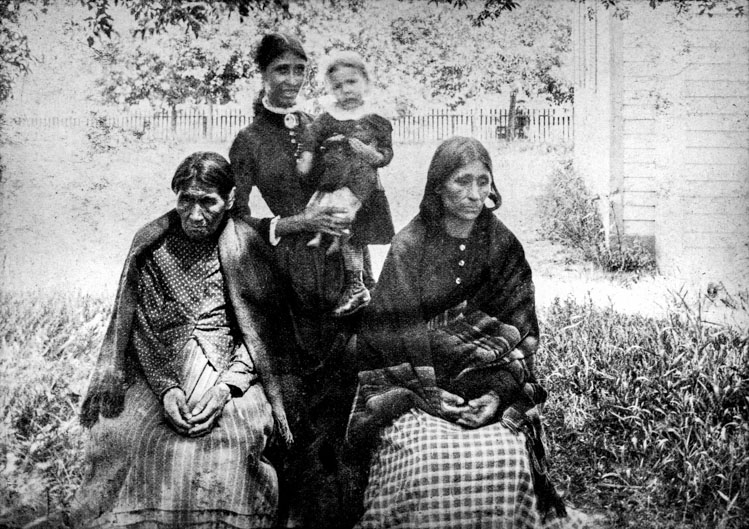 |
| Elizabeth Winyan (standing) was long associated with the Riggs family, caring for young Thomas in Minnesota and later joining him at Oahe Mission. |
On a spring day in 1830 a family, including a 3-year-old girl, was harvesting sweet syrup from maple trees along the banks of the Minnesota River near present-day Mankato. Suddenly and viciously, they were attacked by an unidentified rival tribe.
The girl’s father was one of several Dakota Sioux killed in that attack. The young girl’s mother realized she could not escape the deadly melee while running with two children, so she emptied a pot of boiling water and hid the girl underneath. She then picked up her son and ran to safety.
For two days and one night the little girl stayed silent under the kettle. Then, her mother crept back and retrieved her.
“Even in her old age,” wrote historian Thomas Hughes, “Winyan never forgot that terrible experience and how, when her mother lifted the kettle, the moonlight showed on the bloody faces of the outstretched dead, her father among them.”
Winyan, who would later be given the name Elizabeth while working with Dakota Territory missionary Stephen Return Riggs, spent the rest of her life serving others. In Dakota, Winyan means mother and protector. She lived the name. Winyan was a human bridge over the most difficult waters of Dakota Territory and early statehood, when the federal government sought to force rapid assimilation of Native people, in part by creating reservations. By the time she died six decades later, Winyan was a legend among Native people, white missionaries and settlers on the Dakota frontier of the 1870s and 1880s.
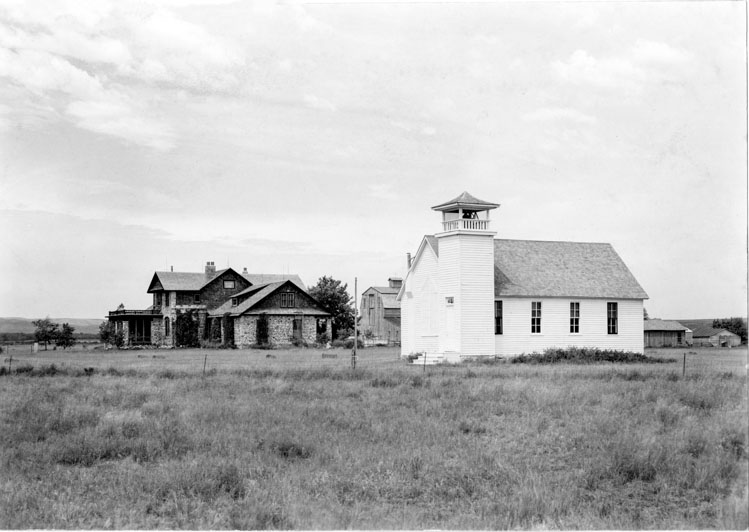 |
| Oahe Mission Chapel, next to the Riggs family home, was built in 1877. When Lake Oahe flooded the site it was moved to the Oahe Dam Visitors Center, where it stands today. |
She often traveled the preaching circuit with the Riggs missionaries, blending her mission work with knowledge and practices of her own Dakota people. The Sioux, with a rich oral history tradition, have tried to keep stories like Winyan’s alive, but in the written annals of Dakota Territory her works are sparsely mentioned.
“She was amazing in her time,” says Winyan’s great-great-great granddaughter, Lora Neilan, of Summit. “And it is sad that it got forgotten.” When Winyan died in 1890, the noted Dakota Territory missionary Mary Collins, a good friend, wrote, “She was one of the grandest women I ever knew.”
Even my introduction to Winyan was accidental, a result of research into an entirely different woman on the Dakota frontier. In 1989, I spent a year studying political migration during a journalism graduate fellowship at Stanford University. While there, I did considerable research on the American frontier, which included paging through countless editions of 19th century newspapers in the archives. One advertisement in an 1888 edition of Minnesota’s St. Paul Daily Globe caught my eye. In huge type, I read: “SHE LOVES A SAVAGE!” It was an advertisement for a dime museum appearance of Corabelle Fellows, a young white missionary, and her new husband, Sam Campbell, a mixed-race man of Dakota Sioux and white blood.
I suspected there was a good story behind this headline. I tucked away a copy of the ad and years later, decided to investigate. I have often been surprised by how few female and Native voices are used in the telling of the history of Dakota Territory. I thought Corabelle may have something to say. This hunch — and years of research — resulted in my book Life Painted Red: The True Story of Corabelle Fellows and How Her Life on the Dakota Frontier Became a National Scandal.
The book follows young Corabelle and Sam as they set out on the sideshow circuits and Buffalo Bill’s Wild West show to make ends meet after Corabelle’s family disowned her for marrying a man of mixed blood.
During my research I also discovered Winyan, who had played a role in Corabelle’s early missionary work. In the winter of 1885-1886, she was in her third year of teaching and serving in missions in Nebraska and Dakota Territory. That winter, one of the coldest and harshest on the Plains, she lived and served with Winyan from a rough-hewn cabin at the Oahenoua village on the Cheyenne River, northwest of present-day Pierre. It was one of the most isolated posts on the frontier, serving people who had recently returned from exile in Canada with Sitting Bull. By then, Winyan had gained a reputation as one of the physically strongest women in the territory. She built the log cabin she lived in, hauled water uphill from the river and traveled long distances through harsh conditions to nurse the sick or dying.
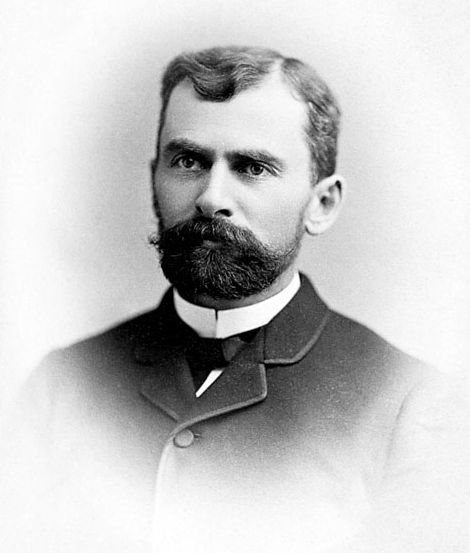 |
| Thomas Riggs. |
Living with Winyan that winter, Corabelle, whose mother immediately disowned her after the marriage to Campbell, began calling Winyan “Ina,” or mother. Winyan had initially gained notoriety when, as a young woman during the bloody Sioux uprising in Minnesota in 1862, she secretly swam food to an island in the Minnesota River where Riggs and a small band of fellow missionaries and Sioux friends had hidden with their families. After her father died, Winyan had been taken under the tutelage of Riggs and his fellow missionary Thomas Smith Williamson. When the Dakota people in Minnesota were pushed west to reservations, the missionaries went with them, so Elizabeth gave up her life among the lush fauna of the Minnesota River valley to the harsher, starker and more expansive high plains of western South Dakota.
The granddaughter of the legendary Dakota leader Sleepy Eyes, she had grown up with a strong connection to the natural world. Winyan helped raise several generations of Riggs children, nursed the ill with herbs and practices passed on to her from her ancestors and sat with the dying when others were too afraid of evil spirits.
Tales of her physical strength spiced Sioux oral histories. Stories of her quiet mercies were also abundantly shared. “Winyan was a woman of strong character, fine mind and a natural leader,” the historian Hughes wrote. “Her great desire was that her people should hear the Gospel, so as the years went by, her work widened, and she was sent to various fields. She held meetings, discussed the Bible, visited the sick, buried the dead, and occasionally addressed conferences of white people. Even the Indian men held her in the highest esteem.”
Collins, the missionary, was struck by Winyan’s loyalty, her knowledge of her people’s past and her understanding of the natural world, particularly the constellations in expansive prairie night skies. “She is a faithful friend, true to her character as a Dakota,” Collins recalled. “She enjoys camp life with us, and evenings, as we sit by the campfire, she will tell stories of her early life, or fables, or legends of the stars. She is quite an astronomer. She reads the sky like an open book.”
Together, during that rough winter of 1885-86, the broad-shouldered Winyan teased Corabelle — barely 5 feet tall — about being able to keep up with physical work. Hauling water from the river to the cabin, Winyan would balance two large buckets on her shoulders, often while plowing through new fallen snow. Corabelle would follow with one pail, struggling, but rejoicing in Winyan’s eventual approval. “She always looked me over skeptically when we reached the house” after hard work outdoors, Corabelle recalled. “Invariably, when she found me unbroken, she would put her hands on her hips and laugh so hard that I was obliged to join her.”
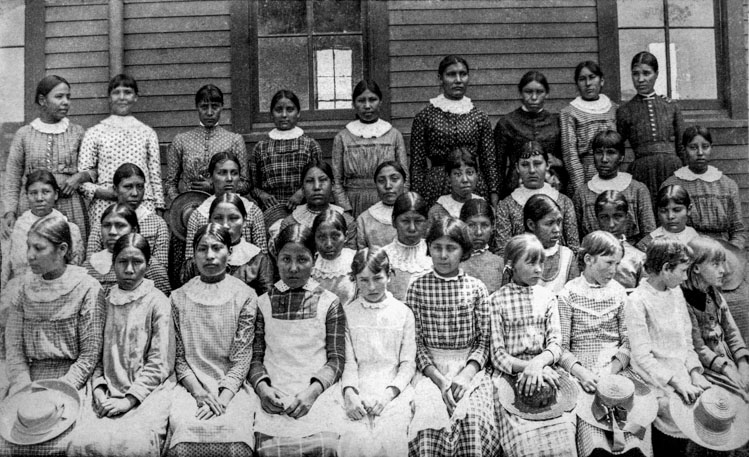 |
| Thomas Riggs established Oahe Industrial School in the 1870s as a training school for girls. |
One night in the middle of that winter, Winyan fell asleep while Corabelle was teaching a group of young Sioux men. One of the men later returned to kidnap the bewildered Corabelle, catching her as she came outside to do a chore before bed. Winyan, awakened by a rush of ice-cold air from an open door, plowed through snowbanks to catch up with the young man, who had wrapped Corabelle in a blanket and was carrying her to his home.
“What bad thing is this!” Winyan shouted, shooing the man away. “Now you stop!” Her unwelcome suitor dropped Corabelle in the snow. Winyan wrapped her in a blanket and escorted her back to the cabin, where she consoled and soothed her with an herbal bath. Winyan scolded Corabelle for carelessly ignoring her warning to never go outside alone.
Corabelle and Winyan talked long into that night, marveling at how this white missionary and the Native missionary ended up together after growing up in such different worlds of culture, customs and religion. “How we talked,” Corabelle remembered. “Really talked, there in that crude cabin, shut away from the rest of the world. She asked and answered, and I asked and answered until that day, with its closeness of spiritual touch, became a highlight of my whole life.”
Missionaries and newspaper reporters alike simply called her Winyan. Eventually, she had a son, Edward Phelps, a minister, who along with his wife, Ellen, became missionaries and served rural South Dakota churches.
In her 50s, Winyan began speaking more frequently to donors and churches, traveling as far as Chicago. Neilan, Winyan’s descendant, has collected photos and articles that highlight her impact. Winyan’s life spanned the great events of the 19th century frontier: the government’s many treaties with the Sioux; the 1862 uprising in Minnesota, in which hundreds of white settlers and Native people were killed, and which ended with the mass hanging of 38 Dakota men; the many battles and massacres between U.S. Army forces and Native people on the Northern Plains in the mid- and late-19th century; the last stand of George Armstrong Custer’s 7th Cavalry on the rolling Montana hills in 1876; and the rapid settlement and statehood of South Dakota in the last quarter of the 19th century.
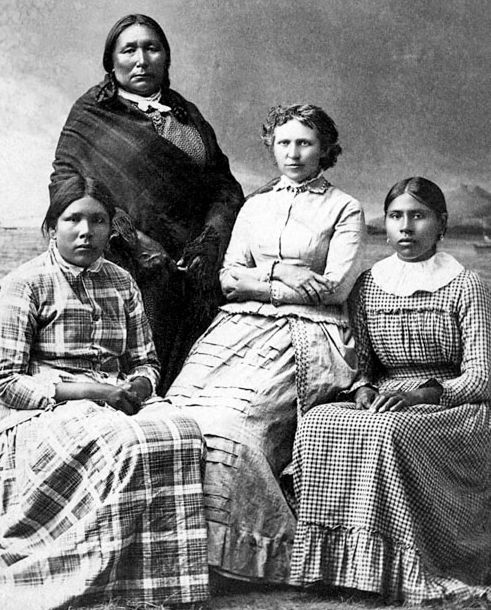 |
| Louisa Riggs considered Elizabeth Winyan (standing) a colleague. She is pictured with Mary Collins (second from right), another missionary. |
“She was a legend,” Neilan says. “What I found out, in the time frame that she lived, with the racism she faced and everything that had happened, I am most proud of how she rose above that, of how she left her mark and how many other ones did as well.”
Even while helping Native people adapt to relocation to the reservations, she often quietly longed for her childhood life along the Minnesota River. “She missed it so much,” Neilan says. Once, when sitting with fellow missionary Collins, Winyan told of something she had just seen that “well represents our present condition as a race.
“A man named Longfeather, dressed in Indian dress paint and feathers, was teaching some boys the Indian dance and song,” Winyan told Collins. There were three boys: One with long hair and painted face and Indian dress, one with shirt and leggings and a white boy’s shoes and stockings on, the third dressed well in entirely white men’s clothes. “One represents the past, the second the present, and the third the future,” Winyan said. “I know it has to be, but to me the one dressed all in the Indian child’s clothing looked the best, but I’m only an Indian.”
Neilan finds inspiration in her ancestor even today. She says she and her daughters (Lauren, Bailee and Falon) have also begun to study native plants, and to learn about the constellations that illuminate our prairie nights.
“She was a beacon,” she says, “a beacon of power in her own self.”
Chuck Raasch is a native of Castlewood and a graduate of South Dakota State University. He has written for the Huron Daily Plainsman, the Sioux Falls Argus Leader, the St. Louis Post-Dispatch and USA Today. Raasch has also authored two books, Imperfect Union: A Father’s Search for His Son in the Aftermath of the Battle of Gettysburg, published in 2016, and Life Painted Red: The True Story of Corabelle Fellows and How Her Life On the Dakota Frontier Became a National Scandal in 2023.
Editor’s Note: This story is revised from the January/February 2025 issue of South Dakota Magazine. To order a copy or to subscribe, call (800) 456-5117.

$29 for 1 Year |
 |

Comments
I often enjoy your newsletter articles more than the articles in the magazine. Recently the article on mountain lions, the one in this edition on Rockford (sadly, to be a memory only with Moonshine Gulch’s Facebook acct.
I understand you are covering the whole see state, bit I am totally uninterested in baseball & bow making.
Thanks for repeating this great article!